Sunday, 2 January 2022

December Books Read Part 2

 January has welcomed us with our first snowstorm of 2022.  That didn't take long!  Much colder air is arriving as well.  At least we are quite used to staying indoors by now.  That is one of the reasons why I read so many books in December.  I was finished my required reading last month by the 15th, so on the 16th I began the first of 6 books not related to the Avon/Equinox SF authors.  Three of the six books were real, live books, and three were Kindle reads.  Three were SF, one was an art book, one was classic fiction, and one was a mystery story.

First up was Station Eleven, a tale of post-apocalyptic Ontario and western Michigan after a virus has ravaged the world, killing over 99 % of the people very quickly.  Imagine my surprise as I neared the end of Emily St. John Mandel's absorbing novel to read in the Globe and Mail newspaper about a new HBO series just coming out called Station Eleven.  I will have to subscribe to another paid channel if I wish to see it, and I probably will.  The first episode should tell me if I will continue to watch.  I have read so many books in the past 5 1/2 years that I now much prefer them not to be made into anything to do with TV or movies.  But I will give this one a try soon.  There are ten episodes, and so far 5 have been released for viewing.  I liked the book a lot, though Emily owes much to writers like John Christopher and Edgar Pangborn, both who have written exceptional novels of post-apocalyptic life.  Highly recommended, the book was written in 2014, not long after the SARS scare.

Next up was Olaf Stapledon's first novel, called First And Last Men.  There are very few writers with superb imaginations that are able to put down on paper exactly what they are thinking, in terms that we mere mortals might comprehend.  This is a novel (from 1930) that greatly influenced generations of SF writers, and is still regarded as one of the best SF tales ever told.  It relates two billion years of human history, from today through then, in a most astonishing tale of success and failure.  What Stapledon has managed to do is provide enough material for future SF authors to write literally thousands of additional novels, filling in the details he has forced to skim over.  If ever there was a SF novel to end all SF novels, here it is.  It is a fairly long book, but broken up into manageable units, and not difficult to read if taken a bit at a time.  There is a lot of food to chew on, so chew slowly and enjoy.

Next up was another SF classic, this time a reread for me.  The House On The Borderland is from 1908, written by William Hope Hodgson, the man who brought us The Night Land.  I haven't read it in many years, and though it is much easier to see the flaws today, it is just as easy to become engrossed in one of the best horror novels ever composed, one that Lovecraft would try and copy many times.  The setting is a large, lonely house on the Moors, and it happens to sit atop a gaping hole that goes deep into the earth.  Very strange and threatening things happen at the house, and we are there for all of them.  This is a must read for fans of the genre.  Don't expect great writing, but expect some wonderful chills and mysterious doings.

Rock With Wings, by Anne Hillerman, is a continuation of her father's famous mystery stories set in Navajo land in new Mexico and Arizona.  She uses the same characters as Tony, but we now see things from a female officer's perspective.  Bernie Manuelito and Jim Chee are a couple, and they both are sworn officers of the Navajo police.  Their beat covers a vast area, thinly populated, where cell phone service is often absent, and even police car two way radios don't work.  This is her second book (she has six so far, and another on the way), and it is quite good.  We get a mix of police work and life on the reservation.  This plot involves a zombie movie production on location at Monument Valley.  Well done.

The Cincinnati Museum of Art has long attracted our attention, and when Deb had films accepted in the Cincinnati Film festival two years in a row, we visited the city again both times.  I was able to spend a luxurious day at the main art museum, one of two in the city.  I recently reread Dutch, Flemish, and German Art In The Cincinnati Museum of Art, a catalogue of paintings.  I was reading this while reading the above novels, focussing on a painting or two each day.  While the collection is much smaller than the one at the DIA (for example, Detroit has more 17th Century Flemish paintings than all of Cincinnati's Dutch, Flemish, and German art from all ages combined), there are choice paintings here that too many people will never see.  Like many museums, their choice Rembrandt selection was downgraded a few years ago to Studio Of..., but there are still plenty of autogrpah masterpieces to see.  I also have their Italian paintings catalogue, but now I am embarked on a DIA catalogue of American Art, Volume Three of their American painting collection (which is vast beyond words).  Cincinnati is a beautiful Midwest city of the shores of the Ohio River, and their main art museum is a world class institute that will never disappoint visitors, even ones like me who have been there many times.

Last, but not least, was Joseph Conrad's Outcast Of The Islands.  This was his second novel, though the events in it are related to Almayer's Folly, his first novel.  The events in Outcast take place prior to those in Almayer, with several of the same characters present.  No one writes like Conrad, or as well.  That man could handle a sentence, a paragraph, and a chapter in such masterful ways as to leave readers gaping open-mouthed at his prowess.  His use of nature as a foil to human emotions and deep, inner thoughts is brilliant and unique.  He tackles racism and White feelings of superiority head on, portraying characters not so much as mean or evil towards their "inferiors", but merely clueless as to what they are really like, their thinking and their potential.  Why are dark people inferior?  Because white people say so!  The story revolves around Wilhelms, a Dutchman with a respectable job with a major trading company.  He loses at poker and borrows from the company to pay his debts.  He is caught, disgraced, and forced to leave the area forever.  Captain Lingard (who is in all three related novels) takes him to Almayer, where he proves to be not only his own worst enemy, but Almayer's and Lingard's as well.  In my early 30s I first got seriously interested in reading Conrad.  Now that I have the Delphi collection of complete works, I can finally read his entire canon.  With greatest of pleasure.

If you have a few more minutes, I will go on to show another work of art from the DIA collection.  It's been awhile!  I think from time to time about one of the exhibits we saw in Vienna in December 2018.  The museum chooses a celebrity, allowing him or her to select anything from the storage rooms and to create an exhibit.  We happened upon one created by Wes Anderson, and it was totally brilliant!  I like to fantasize about me being allowed into storage at the DIA (I was allowed in once!), and being able to form an exhibit based on what I came across.  The last print exhibited here (False Faces), and this one, would likely be involved.   

Le Stryge, 1853.  Charles Meryon, French, 1872-1907.  Etching printed in black ink on Japan paper.  13" x 10".  Collection Detroit Institute of Arts.


2 details of above. 

There is some fresh snow on the ground, and the temp will remain below freezing all day today and tomorrow.  It feels like January.  On the bright side, the days are growing longer, and we are already 12 days into winter, being that much closer to Spring.  I would linger here, but there are books to read, movies to watch, piano pieces to practice, and laundry to do.  Until next time.

Mapman Mike


Saturday, 1 January 2022

December Reading Part 1

It was a good month for devouring books.  There hasn't been a single clear observing night in the entire month so far, which means more evenings at home, and thus more reading (and writing--more on that later).  I led off with the remaining eight authors of my Avon/Equinox SF Rediscovery project, and completed the cycle in a record 15 days.  That left me with 16 days for free reading, and I managed to get through six more books, including a non-fiction art catalogue.  I will discuss those six in a future blog.

Robert Silverberg's Born With The Dead is from 1974, and is 94 pages long, making it a short novel or long novella; take your choice.  Sometime in the near future it is possible for rich people to return to a sort of afterlife after their death.  When a man's wife dies in her 30s, she becomes one of the living dead.  Even though she now has a new type of life with a new group of friends, her husband can't let go and tries to meet with her, which is never allowed.  At first unsuccessful, he at last gets to talk with her, though it doesn't go as he had planned.  A second attempt brings the story towards its conclusion.  The story has its creepy aspects, as the dead people live lives quite different from the rest of us.  The man's wife continues her research work, but also takes up game hunting, something she never did before.  And her research and travels, along with those of the rest of her dead companions, seem to focus on ancient history, ruins, and aspects of peoples lives of long ago (which sounds pretty good to me).  A good story, and certainly long enough for the idea it explores.  Recommended, and would make a good SF film.

Piers Anthony's 3rd entry in his Bio of a Space Tyrant series is called Politician, from 1985.  Hope Hubris runs for office this time.  Though the book can be considered SF, it really isn't.  It's a parody of American politics during the Nixon administration, though for readers of today it comes much closer to the doings in the era of Trump.  Many things that occur towards the end of Politician are frighteningly close to what happened during the Biden/Trump election in 2019 and afterwards in early 2020, and still continue to this day.  The book is also a pretty good way to get younger readers to learn something about American politics.

 For the most part, I actually liked this book.  Readers of any recent reviews of mine regarding Anthony's later writing may be surprised by this.  If I'd read this novel ten years ago, or even five, I would have laughed at some of the things that Hubris had to face after he won the election.  Now I just nod my head knowingly.  I wonder what Anthony thinks of Trump's attempt at a coup; I think I have a pretty good idea.  Should you feel the need to learn something about American politics in a fairly entertaining way, then this is your big chance.  If you are merely looking for a good SF story, you might want to look elsewhere.
 
The Stainless Steel Rat Sings The Blues is from 1994, and continues Harry Harrison's most successful comedy SF series.  As is usual for the author, there are some serious themes mixed in here, as well as some great send ups of pop music, for example being able to form a band and be ready in one week for a road show.  Male chauvinists, male dictators, males with swollen egos and with inflated images of themselves also can taken down a peg or three.  All in all, a fun book to read, and the pages turn quickly.
 
Kenneth Bulmer, like many pulp writers, used many different names in his career.  He wrote a two-book pirate adventure under the name Richard Silver.  The first one is called By Pirate's Blood.  This first one is from 1975 and is 146 pages.  Solidly within the pulp tradition, and thus catering mainly to male readers, the story is an easy read and packed with action and adventure.  Sebastien Shark is an English buccaneer, not a pirate, if you please.  Set in the 1670s in the Indies, the Spanish are the bad guys here, as are real pirates.  Real pirates will attack any ship, even other those of other pirates, but buccaneers are English, and will only go after Spanish ships.  If you like rousing action on the high seas, here is a first rate example of what is available.  Bulmer pulls no punches, and the story has violence galore, as well as sex and murder.  With a loyal bunch of cutthroats at his back, Shark is able to escape capture by the Spanish, who long to torture him before killing him.  Bulmer is in top form here, and the book is recommended once the reader knows what is in store.  
 
E C Tubb's entire ouevre is out there on Kindle, for good or bad.  Planetoid Disposals Ltd was written under the pen name (which I love!) Volsted Gridban.  It concerns a company formed to keep space lanes clear of asteroids and other debris.  This is typical SF pulp fiction, much of it silly nonsense, but it must have had wide appeal in the early 1950s.  There is only one female in the story, and though she is a good space pilot, her job is to mostly stay home and let the men take care of things.  Then, and only then, can she marry Steve.  This is pretty basic SF writing.
 
 Jack Williamson's Mazeway is a sequel to his superior LifeBurst, hampered by a weak central character, and an evil alien presence that no one seems to notice.  It's still a good read, especially having read the first book.  In this one we get a good look at life on Earth after the devastation caused by the previous evil alien's baby.  Life isn't pretty, let me tell you.  There are some wonderful alien landscapes in this one, mostly underground, where a bizarre competitive game is played out by teams of intelligent beings.  Groups of three are dropped off at a given position, and must make their way to another area some distance away.  The planet where these games are played is riddled with tunnels and tubes, from the original race (now long gone) who mined the planet nearly to its core.  The underground playground is a dangerous place, however, and not all teams make it out alive.  The edition I read has the distinction of winning this month's best cover art.

Cover of the month for December 2021.  Art by Don Dixon. 
 
Next up was Michael Moorcock's 1982 The Brothel In Rosenstrasse, a superb bit of fiction mostly taking place in his imagined ideal European city of culture (resembling an early version of Prague), and loosely tied in to his Von Bek series of novels.  The book begins slowly, and I could see readers giving up on it after 50 pages or so.  But it just gets better and better as it moves along, until finally it's hard to put it down. Essentially the story is about a man (a Von Bek) dying in his bed, looked after by an older man, a servant.  Von Bek is writing his memoirs, and his thoughts go between the present and the past, often in the same paragraph.  Von Bek was a rake (at least in his own mind; we never know for certain if he has imagined some things from his past life or really lived them all.  He takes a young lover, a girl of 16, whose parents have gone to Italy and left her with a relative.  They end up in Mirenburg, in a hotel at first, but then move to rooms in the brothel.  The second chapter deals with events and happenings at the brothel, and the people who frequent it.  At this point the book becomes fascinating for its unsentimental look at the lives of the women who work there, and the clients who visit.  There is a good deal of sex, some of it extreme and some of it violent.
 
The third chapter deals with a war, and the siege of Mirenburg.  This mirrors the siege of Paris, a true event in 1870, and how people survived during the bombardment, but is even more harsh and terminal than the original siege.  The finest preserved city in Europe is totally destroyed by the invaders.  Von Bek and his young little Alexandra plan to leave the city via the underground sewer system, but when he is stood up his life seems to come to an end, just as the city itself is destroyed.

I loved the book, except for the slow exposition, and was soon immersed in European fin de siecle decadence at its finest and most intimate.  Moorcock has created much truth with this fictional account of a man who loves young girls, especially his Alex.  It is not a book related to much of his other writing.  The only fantasy element is the city itself, and the fact that Von Bek's memories might also be largely fantasy.  In a book filled with quotable moments, I have chosen only two.
 
    "Man's greatest monuments, his architecture, never outlast his acts of aggression."  P. 181.

    "Greed is not evil.  What is evil is the manipulation of others in order to satisfy it; the quest for power.  That is the crime." P. 187. 

I highly recommend the book, but it is for serious adult readers.
 
Lastly in my required monthly reading came the next novel by Barry Malzberg.  Called Conversations, it is from 1975, and continues his short narratives about a very controlling future world.  It concerns young people growing up inside a vast building, kept from the savage outside world, and forced to submit to the will of a group of elders.  The building is 40 floors in height, and each floor holds 1500 rooms, so the population is sizable.  Dal is twelve, and lives on the 20th floor.  He comes under the dangerous influence of Lothar, 14, who is secretly holding on to magazines from the before time, with advertisements showing happy, smiling people, including families.  The children of today are separated early from their parents, and live in small enclaves, and are taught to look out for one another.  When his friends see Dal coming under the bad influence of Lothar, he is reported.  The book is easy to read and has moments that will linger long in the reader's mind.

Tomorrow I will write about the six other books I read in November.  We are currently under a winter storm advisory,and are expecting some decent amounts of snow an a blast of cold air tonight.  We enjoyed a music-filled New Year's Eve, but it was too warm to have an indoor fire.  Deb is currently off to visit her mom in Kingsville, and should be home well ahead of the oncoming storm.

In movie news, there are two films to report, both my choices.  Both were leaving Criterion Dec. 31st.  The first was directed by John Huston, called The Treasure of Sierra Madre.  There are movies, and there are movies.  This is one of the latter.  One of the best adventure films of all time, Humphrey Bogart plays a man down on his luck who joins with two others to go in search of gold in the Mexican desert mountains.  Walter Huston plays the old coot who has more know how than either of the other two put together, and leads them to a high degree of success, despite all the hardships, including some famous Mexican banditos ("I don't need to show no stinking badge!").
Two of them end up okay by the end, but Bogart's mental deterioration, caused by his gold lust, becomes complete and terminal.  A classic which we haven't seen in many years.

No longer showing on Criterion.

Next up was a quirky but heartfelt animated feature called Mary and Max.  An Australian film from 2009, it tells the very touching story of pen pals Mary, a lonely and homely child from Australia, and Max, a severely obese adult male who suffers from Asperger's Syndrome. The film spans twenty years in their on again off again relationship.  Some of the humour is very dark, and at the expense of several pet goldfish, but there is much to love about this film, which also has haunting moments that most real acted films would not dare approach.  Definitely worth catching, if you are lucky enough.
 
No longer showing on Criterion, but definitely worth seeking out. 
 
Over the holidays we had the great misfortune to watch the 270 version of Einstein on the Beach on blue ray.  This is possibly the world's leading example of over indulgent, pretentious crap.  Because of Robert Wilson's "vision" and execution, Glass' music has to loop ad infinitum to get through a scene.  Filled with contorted faces, repetitive body movements, meaningless snatches of poetry repeated ad nauseam, anyone who can sit through this in one go should be locked away in an asylum.  A lot of people continue to be taken in by this gloss.  The full version stinks to high heaven.  Now, there is a CD (music only) of musical highlights, which sounds more like what I might listen to again.  But if anyone wants a blue ray copy, let me know--it's available.  P.S.  This is not an opera by any definition.  It is a vastly overextended piece of bad performance art, that should have been left in the dung heap in 1976.  Instead, it keeps magically reappearing from time to time.  I remember when this version was presented several times in Ann Arbor, before it set out on its world tour.  I did not go near it then, and I should have stayed away now.

Mapman Mike


Sunday, 26 December 2021

News Fit To Print

 It's been a pretty calm week around the Homestead, and we are both hoping for more of the same.  Weather continues to be autumnal, and it's one of the greenest holiday periods we've ever seen.  We had a lot of rain on Christmas Day, spoiling my chance for an afternoon of hiking at Point Pelee National Park.  Deb wanted to spend a longer time with her mom on Saturday, so I had plans for a shorter visit, and then to go hiking.  Instead, I came home for a few hours, then drove back to pick up Deb in Kingsville.  Today it is bright and sunny.  Of course.

I spoke with my parents at length both on Christmas Eve and Christmas night.  They are both fine and doing quite well, though Dad is still barely mobile due to a bad knee.  As our local Covid cases surge, it looks like we will be hunkered down in January.  It's usually a good month for such activity anyway.  And of course it has been continually cloudy at night, so astronomy has been a no go.  At least I've been practicing piano regularly, and doing a lot of reading.  I usually read about 2 1/2 hours each day, and practice piano about 1 1/2 hours each day.  The exercise program continues as well, around 2 1/2 hours per week, until more is needed.

The shipping channels over here are as busy as ever, but the northern locks will likely close soon.  I have seen shipping continue year round once or twice, and this might be another year for it.  The Amherstburg coast guard ice breaker is in place, but there is no ice in sight yet.  I read a fun article yesterday, on the Accu Weather website, about the tradition of wanting a "white" Christmas, referring to fresh, fluffy snow on the ground.  I always wondered who to blame for such nonsense, and it seems I now have my target in sight.  It likely all started with Charles Dickens, but since then it's gotten way out of hand.  Kind of like ground hog day.  People seem starved for any time of "tradition", rather than trying to establish their own, or observe the real ones that have been around for millennia, such as the solstices.  It's a funny world peopled by funny people.

Our own Solstice Day celebration was a blast.  It was just barely cold enough to warrant an indoor wood fire, though it was of shorter duration than other years.  We sampled the first disc (of four) of Philip Glass' Music In Twelve Parts, and then listened to the CD called Glassworks, and another one called Philip Glass-Piano Works, performed by Vikingur Olafsson.  He is a favourite pianist whom we heard perform in London several years ago.  I already chose a piece from this collection to perform on my next next recital (probably late 2022).  And tonight we will give Einstein on the Beach a go.  We purchased a Blue Ray disc of the opera in early December, from Germany, and it arrived Dec. 22nd.

Just as the pandemic was getting underway in the late winter of 2020, we had booked flights to San Diego.  We had to cancel at the last minute, as Deb wasn't feeling well.  That week the disease exploded in California, so it's just as well we didn't travel then.  We had full insurance to cancel (through Orbitz) and got a full refund on our flight, hotel, and car.  So imagine my surprise when I looked at our Orbitz account recently and found out that we each have $373 in Delta flight credits, good until December 2022.  I don't know if it's a mistake, or why they are there.  We were refunded by the insurance company, and yet the flights are still available to us.  Hopefully we will get a chance to use these credits in 2022.

Other than movie talk, that's all the news for now.  So, on to movies. 

My two choices last week were Heaven Can Wait, directed by Lubitsch and from 1943, and Belladonna of Sadness, an animated feature from 1973 Japan.  Of the two, I preferred the Lubitsch, a gentle comedy about a man dying, meeting the devil, and telling him his life story, before being sentenced.  It was in colour, and had some wonderful lines.

Showing on Criterion until Friday night.

Belladonna is an adult animated feature, purportedly taking place in medieval times.  On her wedding day, a young woman is raped by the lord of the manor and his friends.  The movie is graphically sexual, though largely through symbolic images, and violent.  It doesn't pull any punches, as the woman survives and slowly becomes corrupted by vengeance.  The film is sometimes hard to watch because of flickering imagery, and should have come with an epilepsy warning.  Some of the animation techniques created some truly beautiful and stunning imagery, often seemingly at odds with the unrelenting horror of the material.  A very strange film from the psychedelic era.

Showing on Criterion through Friday.  

Deb's two choices were also from the Leaving Dec. 31st film list, and just as opposite one another as my two choices.  First up was The Mummy, from 1932, starring Boris Karloff as the reactivated man in love with his princess.  It is remarkable how easily he adjusted to life in 20th C. Cairo, after having been asleep since around 1700 B C.  He also has a very stylish apartment, with an indoor pool of water that gets remarkably good reception on various live channels, as well as ones from thousands of years ago.  Some creepy moments, but mostly still fun, in a dusty sort of way.

One of the great movie posters of the 30s!  Showing until Friday on Criterion. 

Eat A Bowl of Tea is from 1989, by director Wang Wang.  Based on a novel by Louis Chu, the setting is 1949 New York, just as the American government is finally allowing Chinese immigrants to return to China and bring women and families back to live.  With the current local population totally male, a young man makes the journey back to China, finds a bride, and returns with her to new York.  Dad immediately wants a grandson, but there is trouble on the horizon, as the son cannot seem to consummate the marriage.  Mostly a funny glance back at a very weird time, there is enough drama to satisfy those without a sense of humour.  Well acted, especially by the old timers.

Showing on Criterion until Friday. 

Mapman Mike


Monday, 20 December 2021

Winter Solstice 2021

Just watched a beautiful Solstice Eve sunset tonight, and there is hope we might even see the sun tomorrow, too.  It's seasonally cool, which is good news for our all day indoor wood fire, and we have a suitable stack of Philip Glass CDs ready to roll out.  We have to pop out tonight for some groceries, usually done on Tuesdays.  Otherwise we are all set for our big holiday!

On Saturday the weather was quite different.  I went to Kingsville with Deb, as I needed birdseed. While she visited her mom, I visited Lakeside park, mostly reading.  However, it was raining hard and 33 F.  Let me tell you, that was a cold rain!  And there was an ill wind blowing too, from onshore.  One or two degrees colder and we would have had a nasty ice storm on our hands.  I got out of the car at one point for a five minute stretch, managing to take three photos.  I took a quick walk to the garden area, searching for flowers.  I found one group of very tiny ones, still mysteriously blooming on one of the darkest, most miserable days of the year. There might be a message in there somewhere for us all.

A dreary and cold day at Lake Erie.  It was raining and 33 F.

A lonely and damp bench at Lakeside Par, Kingsville.
 
Four tiny flowers were blooming in the gardens at Lakeside Park.  Not your usual December in Canada, even if we are in the deep south. 

We watched Alois Nebel, a Czech film from 2011 that fits in well with our ongoing Czech New Wave film festival.  It's in b & w, with a theme that barely distinguishes in from some of its 1960s counterparts.  Only this film is animated in rotoscope, giving it a timeless beauty and sense of depth and perspective that regular films can seldom achieve.  An older railway employee, a station master at a small station, has a nervous breakdown and is put in an institution.  He loses his job, and when he is released he has to go to Prague headquarters to see about another job.  While there he meets a woman, and they seem to hit it off.  The animation allows for some fine special effects, and the quiet story has a dark undertone of the Nazi takeover during the war, as well as the Czech people who collaborated.  At the time of the present story, the Soviets are just leaving the country, and a new democratic president has just been sworn in.  Well worth watching.

Showing on Criterion until Dec. 31st. 

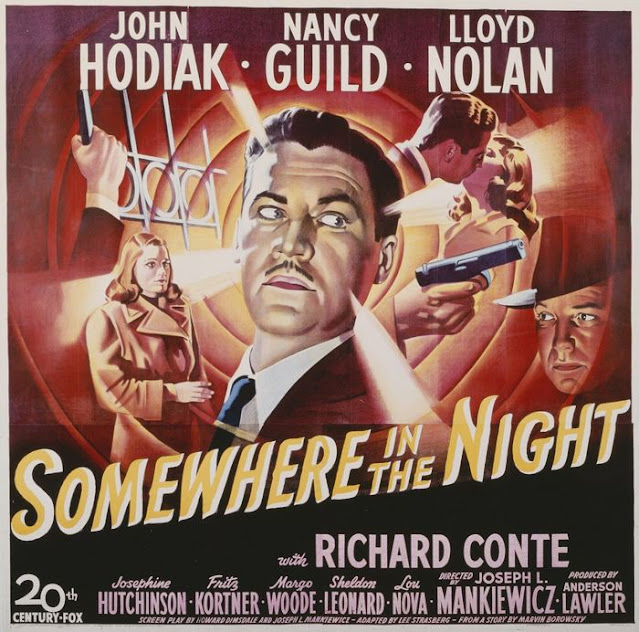
Deb's main weekend choice was Somewhere In The Night, from 1946 and directed by Joseph Mankiewicz.  Before we got the Criterion channel, I thought I had seen most of the great noir films.  I was wrong.  Everywhere you look, there is another great one that we haven't seen.  John Hodiak loses his memory after an act of bravery in Iwo Jima, and is sent home.  He becomes embroiled in finding another man who he thinks was his friend, who was involved in a docklands murder and a two million dollar heist.  With a great supporting cast and some fun lines, the atmosphere is thick and dark.

Now showing on Criterion, and worth catching. 

Deb's leaving Dec. 31st choice is East of Eden, and we should finish it up tonight. 

Happy Solstice to one and all; never fear, the sun is about to come back to us, after its long journey south of the equator.

Mapman Mike


Friday, 17 December 2021

Beethoven and Fitness

Mid-December marks 18 months of personal fitness for me, the longest streak since my late teens.  Had I been stranded in New Mexico for the pandemic, I would have hiked virtually any mountain I desired.  There are still a lot of them, plus a few I would love to reclimb.  Treadmill walking is somewhat different from real walking, however.  This past September, when I did a short trail hike and climb with my niece in Sudbury, I found I had to be quite careful walking on uneven surfaces, and that my balance was easily thrown off.  Before undertaking any mountain hiking I would, of course, have to get used to walking on rocky and uneven surfaces again.  But I figure that I am permanently about 4-5 weeks away from what I call "mountain fitness."  So there would be time to get on trails here before heading back into the mountains.  I fervently hope we can travel by Spring to NM, possibly by car.  I know I said the same thing last year at this time.

Turning now to Beethoven, the anniversary of his naming day was Dec. 16th.  We began our massive biographical and listening program just over a year ago.  While I knew that we wouldn't be finished in one year, I didn't realize how long it might take.  We do some listening every evening, and Beethoven comes up every third evening.  So it probably will take a year, as in 365 nights, to complete the project.  We have probably completed 125 by now.  And where are we?  We are still in the early 1800s, around 1802.  His hearing is going, his health is bad, and he has yet to write his 2nd symphony.  But the Op 18 quartets are done, and many fine piano sonatas, along with two piano concerti.  His early works are still trying to please his mainly aristocratic audiences, though he has been poking quite outside the Haydn/Mozart classical tradition many times, too.  We are following the Biamonti numbering system, which goes as close to chronological as possible, and we have just passed the 300 mark (out of about 900).  I am reading ahead in the biography, and penciling in paragraphs for us to read together as we go along.  Sometimes we stop on a certain piece and hear it in multiple versions.  For example we listened to the 1st Symphony four times, all with different orchestras and conductors.  The one we liked best was directed by John Eliot Gardner, using an orchestra much like Beethoven would have had access to.

In movie news, we briefly turned to Prime for a feature film.  Called The Electric Life of Louis Wain, it stars Benedict Cumberbatch as an eccentric and psychologically fragile artist (Britain seems to have been blessed with an ungodly amount of them).  Most famous in his day for his illustrations of cats, the story of his life is told with great sensitivity and detail.  The only son among a family of girls, it is his responsibility to bring home a paycheck, and though he does his best, he is not much of a success.  Cumberbatch is totally brilliant as the increasingly mad artist, and the make up department did a superb job of aging him as the film proceeds.  You do not have to love cats to love this movie.  It is a beautiful film from start to finish.

Showing on Prime in Canada. 

Deb's "going away this month" choice from Criterion was Out of the Past, Robert Mitchum starring as a private eye who crosses his hoodlum customer.  This is a great and classic film noir, fun to watch from beginning to end.  If anyone trusts a dame in a film noir, you know there is going to be trouble ahead.  Mitchum gets into plenty of it here.  Lots of cigarette smoking, too.  It becomes quite obvious watching these old adult movies, especially the b & w ones, that Hollywood was vastly responsible for encouraging smoking.  With he-men like Mitchum, and beauties like Jane Greer smoking up a storm, how could their fans resist doing the same?

Leaving Criterion Dec. 31st. 

My pick of the week was a very strange film, one of the restored ones from the World Cinema Project.  Called Revenge, it was made by a Kazakhstan director working with a writer from Korea.  If that isn't strange enough, then try the film sometime.  A teacher, in a fit of anger, kills a young girl, then flees the village.  The parents are devastated.  When a son is born, he is brought up to get revenge.  While the story sounds simple, it is anything but.  We travel to many different places, and time passes.  At times we almost forget the revenge element, but it eventually comes back, in a haunting way.  The film comes with an 18' interview with the director, who speaks English well and describes his huge respect and fascination with the writer.  He tries to follow the book as closely as he can, but had to make some concessions at the end.  While certainly worth watching, there are some scenes of animal cruelty that are very disturbing.

Now showing on Criterion. 

Turning briefly back to art, and staying on the theme of eccentric artists, here's one from the DIA that comes with no biographical info whatsoever.  And so I will present the image with no words from me.

False Faces, 1953.  Elemer A. Lakatos, American, 1910-1957. Overall: 20 × 24 inches. No more information is available.  

Mapman Mike


Sunday, 12 December 2021

Another November

While it's not unusual here for months to become reversed as to climate, this December is definitely wackier than most.  We are amidst a strong streak of mild weather more suited to late October and early November, as we race towards Winter Solstice.  The vicious tornadoes that ravaged Kentucky and Illinois overnight Friday manifested themselves here as very high winds and thunderstorms with heavy downpours.  We got 1.2" of rain.  None of our trees blew down, and our power stayed on.  However, there were many trees and poles down in the county and city, with plenty of short term power outages.  Most Great lakes shipping came to a standstill, as the captains wisely steered their vessels into sheltered coves.  Things are back to normal today, and it is sunny, mild, but still breezy.

In domestic news, our fridge died on Thursday.  We had a $90 repair bill to tell us that the fridge had lost its freon due to a leak, and was no longer any good.  After another $2300 spent we have a new fridge, the best one we have ever owned.  However, it didn't fit through the door into the kitchen.  I don't wish to go into any details at this time, as they are too painful to recall, but the fridge is now in its place and working like a charm.  In upcoming domestic news, we also need a new washing machine.  Look for an update on this topic next week.  It's a good thing that we don't have any travel expenses these days.  We still have a $3000 tree to be cut down in our far back yard, though after the recent wind storm our tree guy will likely be far behind again, with us pushed back to the bottom of his list.

In art news, I came across this tiny print by one of the German Romantic artists.  It's the only piece in the Detroit collection by him, but we have seen some of his wonderful landscape paintings, mostly in a travelling exhibit held in Toronto many years ago now.  The image below is larger than its actual size.  Deb is thinking of using it as a location in one of her upcoming short films.  If ever a set for a fairy tale was etched on to paper, this is it.

Old Chapel Under The Trees Surrounded By A Wall, 19th C.  Carl Friedrich Lessing, German (1808-1880).  Etching printed in black ink on woven paper, 3 3/4" x 4 7/8". 

 I have two movies that need reporting, both black and white and both shown on Criterion.  The first one was a tale of highway robbery, starring James Mason and feisty Margaret Lockwood as two swashbuckling highway robbers.  Called The Wicked Lady (great title!), it is from 1945 and was directed by Leslie Arliss.  From the blurb on Criterion's website: "This nasty, subversive treat was the most commercially successful of all the Gainsborough melodramas."  And it's just in time for Christmas!  There is a 1983 remake floating around somewhere, starring Faye Dunaway.

Now showing on the Criterion Channel.

My going away choice (yes, Wicked Lady was my choice!) was called Cluny Brown, from 1946 and directed by Ernest Lubitsch.  Though we had seen it before, it had been many years.  This is a very funny movie starring Charles Boyer and Jennifer Jones, about a young woman who must "find her place" in English society.  Boyer plays a Czech writer fleeing the Nazis just before the war, and Jones is a free spirit who loves working as a plumber.  She gets a job as a maid in a quiet household, and finds out the hard way that Boyer, whom she had met earlier and hit it off with, is a guest at the house.  The picture is a complete send up of the British class system, and is quite hilarious in places, while making its point about how one should behave and not behave.  Boyer is great in this role, one of the few times I really enjoyed his acting.  Movies this good never seem to age, either.  Una O'Connor has no speaking lines, but contributes some very funny moments, making the most of her small role.

Showing on Criterion until Dec. 31st/21 

Mapman Mike


Wednesday, 8 December 2021

Winter Sampler

 The past two days have seen our coolest temps so far this season.  Tuesday it never got above 0 C, but today it managed to just sneak over the freezing mark.  However, predictions are for it to warm up again, through Solstice if we are lucky.  There is no snow; we had 3" early in the month but it is long gone.  We managed to get through an entire astronomy cycle with no clear nights suitable for dark sky work.  This is typical for late November and December, so I am not too surprised.

I'll begin with some art prints today, and move on later to movies.  The following two prints from the Detroit collection come from 1551 (earlier than Bruegel's signature works).  They make a pair, with confusing titles (see below).  These are fascinating works, though I have never seen them on display.

Two Pines and a Cabin Across From A River Town, 1551.  Hans Sebald Lautensack, German (1524-60).  Etching printed in black ink, 6 5/8" x 4 3/8".  Detroit Institute of Arts.  This is the left side of the pair.

Right half of the pair.  See above for info.  6" x 4 1/2".

Deb combined the two prints on her photo program for a full landscape view.  Detroit has two other prints by the artist, both in landscape format.  Of course even in the mid 1500s it was ideal to live alone in the forest, but near a city.  My dream. 

In film watching news, Deb chose two shorter films as her main selection last weekend, and another Robert Mitchum feature from a Chandler novel.  First up was a 62' documentary on Lotte Reiniger, the woman who made outstanding animated films using cut out silhouettes, made famous by her feature film The Adventures of Prince Achmed.  Next came a 62 minute animated feature by Don Hertzfeldt, called It's Such A Beautiful Day.  What a great little masterpiece of filmmaking this is, and I highly recommend it if it can be found anywhere.  Here is a cut from the Criterion description:  "It relates the experiences, memories, and hallucinations of Bill, a stick-figure everyman undergoing an intense psychological journey as he attempts to repair his shattered mind. What emerges is an at once profound and almost unbearably moving meditation on life, loss, death, and the human condition."  Not to be missed!

Now showing on Criterion. 

The Big Sleep is from 1978, directed by Michael Winner.  Though this Robert Mitchum remake has its good moments, it is a letdown after the previous Farewell, My Lovely.  For one thing, Philip Marlowe is in London instead of LA.  For another, there are much fewer of Chandler's quotes in this film, and the supporting cast, despite a list of brilliant names, never really seems to connect with the old school private detective.  And for another, the script just isn't as good, either.  Mitchum is perfect, however, and the movie is fun to watch, wondering when Marlowe will get hit on the head or shot at.

Showing through Dec. 31st on Criterion. 

Until next time...

Mapman Mike