Showing posts with label Ed McBain. Show all posts

Saturday, 30 May 2026

Books Read April/May 2026 and Annual Summary

Because of travel I have combined the last two months.  We were away for the last week of April and the first week of May.  As a result I only read one Tubb and one Bulmer instead of one each month.  I also managed to get through a lengthy Moorcock novel.  The rest is free reading, including four from my Delphi Classics series on Kindle.
 
But the end of May is also the time I look back on another year of reading. It is now ten years since I began the Avon/Equinox SF project (see separate blog).  I am now down to mostly two authors, E C Tubb and Kenneth Bulmer.  I am stepping back even from these two authors somewhat, and will read one book a month by one or the other, instead of both in the same month.  This frees up my time for the Delphi Classics series, as well as for my ever growing list of unrelated fiction.
 
Here is the summary for June to December 2025 January through May 2026.  In total I read 98 books.  22 of those were by authors from the Avon/Equinox SF series, while 71 one of them were novels by various and sundry authors, many from the Delphi Classics series.  My ten year total for Avon/Equinox authors is now at an astounding 898 books!  In the same period I have read 361 books by other authors.   That makes 1259 books over ten years, all reviewed.  I'm a busy guy when not looking at maps.
 
Scorpio Invasion is from 1992 and is 238 pages long.  It is #40 in the Dray Prescott series by Kenneth Bulmer, and we find Dray face to face with the Star Lords once again, after defying them in the previous book.  All is well, however, and he even manages to talk them into following his advice for his next step in serving them.  The Shanks ("Fishheads") are a savage and evil bunch attempting to take over the entire planet and enslave everyone.  Dray has fought them before, but this time he volunteers to go into a city that they have captured and are terrorizing.  He enlists the help of some renegades and like-minded slaves in hopes of timing his attack from within the city with the upcoming one from without.  Bulmer's attention to detail is an awesome feat; I don't know how he kept track of events from earlier books, but he even footnotes where readers can go back and check if they so wish.  Also, his sense of humour seldom lets up, leaving behind all of the much more serious fantasy adventure novels in this aspect.  The novel ends at a cliffhanger moment, so we will have to wait awhile to find out what happens next.  Will Dray Prescott be able to save his friends from slavery, or will he be captured and enslaved himself?  This fun and fascinating series continues to interest me, even forty books on.  *** stars.
 
Incident on Ath is from 1978 and is 188 pages long, #18 in the on-going saga of Earl Dumarest written by E C Tubb.  Any book in this series would make a fantastic SF movie, though the same could be said for virtually any book by Tubb.  But Star Wars marches on.  This time we begin on planet Juba, a place that Dumarest is trying to now leave.  He is being searched for the Cyclan, that race of Cybers--part human, mostly machine) for knowledge he has tucked away in his brain.  This knowledge will advance their cause greatly in their scheme to rule the galaxy, so our hero is always on the run.  Where is he going?  This is the one weak link in this series.  He wants to return to earth, where he was born, but no one has heard of it and thinks it's a myth.  His reasons for returning are never given--when he left as a boy it was a world devastated by war and environmental disasters.  So why not go back and see the old homestead.  Anyway, he hears of the planet Ath, which sounds like the planet he is looking for.  As things turn out, Ath likely had all the answers he needed, but, like the old TV series The Fugitive, Tubb can never give him what he wants.  The computer with the knowledge gets blown up in a man's failed scheme to take over the planet, which has something very much like Herbert's spice.  And so we move on to the next volume.  Tubb weaves an amazing story around these events, with a lot of science mixed in for good measure.  He even includes the arts, with a disillusioned painter and a very beautiful and talented ballerina.  This is one of the better entries in the series.  *** stars.
 
The Whispering Swarm is from 2014, the first book of The Sanctuary of the White Friars series by Michael Moorcock.  The book is 470 pages and is divided into 3 shorter books.  I read one of the shorter books each past month, the first one 190 pages long.  90% of this first book is Moorcock's autobiography, and he throws in a little bit of mysterious goings on in London for seasoning.  I wish he had just stuck to autobiography or to fiction; the two do not mesh very well.  In fact, Moorcock comes out looking like a total idiot, one of the stupidest heroes of any book I have ever read.  Even though he continually wanders into a fantasy London area, he attributes it to LSD.  Really?  Is anybody that dumb?  While he goes on and on about how great his imagination is, the best he can come up with for explaining the strange goings on behind the big gate he sometimes has access to is to say it was LSD.  Very good, Michael.  Very believable.  He becomes one of those characters you want to shake very badly, or see him get run over by a bus.  The fantasy part shows promise, whenever he decides to get more serious about it.  The autobiography is interesting since Moorcock has met so many influential writers.  Right now I have very mixed feelings about the book, as it took 190 pages to convince himself that something strange is actually happening to him.  Great deduction.  More to follow next month.
Reviewed February 2nd/26 
 
The 2nd book of The Whispering Swarm continues pretty much in the same tradition as the first, except that Michael now is beginning to believe something strange is going on.  Ya think?  Was there ever such as moron in fiction who lived to tell the tale?  Michael divides his time between telling us more of his autobiography, how much his loves his wife and daughters, how much he loves the girl from behind the gates he's shagging, and how his tinnitus stops when he goes there.  Yet he still makes no real connection.  In most horror novels such a dimwitted hero would likely die and no one would miss him.  I am coming around to wishinf for that idea in this case.
Reviewed March 1st/26 
 
In the 3rd book of The Whispering Swarm Moorcock continues to use the kitchen sink approach to writing.  He uses autobiography a lot (changed somewhat, of course), fantasy, SF and, in this book, increases the use of historical fiction.  British history is filled with opportunities to write fictional accounts of what might have happened, and is a major genre of fiction writing today.  Moorcock taps into this with his Cromwell versus King Charles I.  He joins a party of loyalists who attempt to rescue the King from prison the night before he is to be executed.  Moorcock and readers know that Charles was beheaded, but with Moorcock and his use of multi universes one never knows where this angle might be going.  Be reassured that history does follow its course, but the reason that the rescue does not come off is that Charles refuses to be rescued.  There follows a climactic scene on the frozen Thames at night during a winter thunder snowstorm.  While the third book in this volume is the best of the three, it still can't really save a sinking ship.  Planned as a series of four volumes, at least one more has been written.  I may or may not get around to it.  If I can pick up the next volume cheaply I will, but that is still no guarantee it will get read and reviewed.  I wish Moorcock had simply written an autobiography.  For now, Moorcock reading and reviews will be rested for a time.
** 1/2 stars
 
My used hardcover edition was read over a period of three months. 
 
Turning now to Delphi Classics I began with another round of stories featuring martin Hewitt, private detective. Just as smart as Holmes, and much more personable, Hewitt and his sidekick Brett tackle a mastermind criminal this time.  Arthur Morrison's The Red Triangle is a series of six stories from 1903.  Mastermind Maes is behind all of the crimes investigated, and though the stories can be read as separate tales, there are ingeniously woven together to form a novel.  Similar to Moriarty and Holmes, Maes is thwarted in all of his misdeeds by Hewitt, and though they do have a final encounter in the sixth and final story, it ends very differently in this telling for the detective.  All of the stories are well written and worth reading, and the linking device used to make us keep reading is a good one.  All of Morrison's Martin Hewitt tales are recommended highly to fans of Sherlock Holmes, and they can stand up against most of Doyle's tales.  *** 1/2 stars.
 
An early edition. 
 
Next came another book by E. Nesbit concerning the Bastable Children.  The New Treasure Seekers is from 1904 and contains several shorter stories loosely linked.  In the first story one of the boys tries to stowaway to Rome, hiding in a clothing basket dressed in a clown suit.  It becomes a true childhood misadventure.  In the next story the children try to concoct a superior Christmas pudding.  This story is pretty funny and more than plausible.  Don't forget to wash the raisins and currents before using them.
The third story is about a distant cousin who visits and is slightly older than the Bastable children. Archibald is also a cad of the first order, but proves no match for his more sensible and decent younger cousins (and their female servant).  In "Over The Water To China" the children get into a situation when they go searching for their lost dog.  It takes them across the Thames from Greenwich and into a very poor area as they follow a lead on their missing dog.  Three of them, led by Alice, end up in a street fight with five thuggish and unpleasant boys tormenting an elderly Chinese man.  After a day long adventure it turns out that the dog wasn't missing after all.
In "The Young Antiquaries" they venture to Red House to meet again with the famous writer who lives there, and this time meet Mrs. Red House, who turns into a very good sport and super fine person.  In the next story their Red House adventure continues, leading to an undiscovered extra room in the cellar and the treasures found there in. 
The next story is one of revenge, but the result is far from sweet.  In the next story the children try to do their writer uncle, who is in Rome, a favour by convincing his London editor that the chapter returned for a rewrite is worth printing as it is.  Good intentions always seem to go off the rails with these children, and this episode is no different.
The final three stories take place at the seaside, after the children are sent there to recuperate following a measles outbreak.  Along with Mr and Mrs Redhouse, a new adult friend is made, the sister of the woman they are lodging with.  It ends by the narrator (Oswald, of course) informing us that there will be no further Bastable stories.  And he was correct.
*** stars. 
 
P D Wodehouse wrote a number of books about upper grade public school boys, usually involving cricket as a central theme.  The Head of Kay's is from 1905 and follows the day to day adventures of several boys at boarding school.  The funny thing about these books, and probably why they were popular with boys at the time, is that there is no mention of actual school work or in-class scenes.  The story revolves around life before and after classes and on weekends.  Girls play no part in the stories, either.  Sport, mischief and getting along with others is a recurring theme, though Wodehouse is such a fine storyteller that a reader can sail through the book effortlessly and not be minded about themes or ideals very much.  Kay's is one of the school houses, identified by the teacher put in charge of it, and old Kay himself is a character to be reckoned with.  His house has a bad reputation and so he pilfers a senior from a different house to try and bring some order to his realm.  *** stars.
 
I brought two books to London with me, one to read at the hotel at night and the second to read on the long plane ride home.  Roddy Doyle's The Deportees and Other Stories was published in paperback in 2007 and contains 8 stories.  All of the stories are concerned with the immigrant experience in Ireland, and while each story has something important to say on the topic, a few say it better than anything I have ever come across.  "Guess Who Is Coming To Dinner" is about a black man coming to dine in a typical working class Irish household, and the father's reaction to the event.  The story is priceless and very well told.  The title story is a sort of followup to the author's best known novel, The Commitments.  This time the band is built using only immigrant talent.  The story is very funny and worth reading just as a lark, never mind the deeper meaning it may have.  It is worth the price of the book.  "New Boy" is a terrific tale of a young black schoolboy enduring his first day in a new school in a new country.  A virtuoso telling of a traumatic experience.  "57% Iris is a funny story about what it means to be Irish, and how such a concept can be broken into a mathematical statement of fact.  Funny and very original.  "The Pram" is a first rate horror tale about a haunted pram and the Polish woman who must push it every day with the baby she looks after for an Irish family.  This is one of the grimmest tales of immigrant experience I have ever read.  All in all this is a rich collection containing several unforgettable tales.  Highly recommended.
***1/2 stars.
 
A terrific story collection! 
 
Outside Looking In is a truly remarkable story by T. C. Boyle from 2019.  It is a fictional look at the history of LSD and its use among early researchers.  The story begins in a Swiss lab during WW II, then jumps to the early 1960s at Harvard.  This is a not very thinly disguised history of Timothy Leary's LSD experiments.  The story centers around Fritz, a grad student studying Psychology, and his wife Joanie and their young son Corey.  Fritz comes under the influence of the very charismatic Tim(othy) and he and his wife begin using LSD for research purposes.  Timothy Leary remains one of the most fascinating characters of the 20th C, polarizing people's views as to his research methods and his use of drugs to gain enlightenment.  While the novel focuses on the early years of experimentation, including several seasons at Millbank and the Mexico summers, the book really dives deep into the milieu of early 60s drug experimentation, with Boyle's focus on one family as a way to show outsiders what was really going on.  Fitz's inability to free himself from the group experience (his wife eventually pulls out with their son), and the fact that his life is going absolutely nowhere, is the tragic outcome of a science experiment that ditched the science and went with the drug experience instead.  Fritz essentially fell into a black hole and was unable to extricate himself.  The final words of the novel are shocking, though we knew all along what was happening and what wasn't.  The search for Truth evaporated into an alcoholic and drug induced haze of existence; it became a never ending party, fundraising event and nothing more.  This is a story that I didn't want to end, but the ending was perfect, as we watch the (sinking) ship sail on.  And on.  **** stars.
 
Timothy Leary and friends get exposed. 
 
A good read to follow up with was Paddy Chayefsky's 1978 novel Altered States.  I have seen the film many times and have always wanted to read the novel.  The author did a lot of research before he began writing it, but he still takes us where no man has ever gone before.  This is a fascinating SF novel about one man's search for Truth, and finding it.  There is a good deal of science talk and the main characters are all doctors of some sort, including medical.  This should not turn off a general reader as the story is as fascinating as it gets.  In the previous novel reviewed above we saw Leary and others fail in their search for Truth through the use of LSD.  In the end they just became addicted to the high.  It would be like just watching the trippy light show scene from 2001 over and over again, rather than the entire film.  The hero in Altered States is just as crazy as Leary, but a bit more serious about achieving his goal.  What a fascinating line of thought to realize that within us might be locked away the entire history of evolution.  Is there a way to tap into it?  Edward Jessop tries an isolation tank, then drugs, then a combination of both before hitting on the bullseye.  Though the film version is terrific, the novel is much better, with clearer goals and outcomes than the film.  The book is pretty short, highly readable and very highly recommended.  **** stars.
 
I read the Kindle edition. 
 
The Starless Sea is a book that I was greatly looking forward to reading.  Erin Morgenstern had written a fantasy masterpiece in her previous work The Night Circus.  I was excited to finally see her second novel arrive at the top of my reading list.  Published in 2019, I can honestly say that the book was a great disappointment.  It is a muddled mess with cardboard characters (less than dolls), no line of direction, and an ending so confusing that I doubt many readers (if they even read that far) came away with anything.  It's the kind of novel that some people might encounter and think they are reading something very profound.  While the ideas behind the book are original and very intriguing, their handling leaves so much to be desired.
 
For starters, the book is way too long. It needs a brutal edit.  That would hopefully knock off about 150 unnecessary pages. The author needs to focus on what it is she is doing, saying and trying to achieve.  None of the characters appear to know, usually a bad sign in a novel.  The lead character is a gay male gamer who gets caught up in a whirlwind of fairy tale activity, most of it below ground.  He is constantly off balance, wondering what is happening to him.  None of the characters grow or change in any way during the novel.  The author seems lost herself in a world of fairy tales, with the Alice stories uppermost in her mind as she writes.  While her fantasy world creations are every bit as enchanting as those found in the Alice stories, Morgenstern's wit and writing skills fall far below those of Lewis Carroll.  I cannot recall a single funny line in the current book, nor any attempt to link what is happening underground to anything above.  Humourless fantasy books become very tiring after a while, and this one really tuckered me.
 
As to the writing itself, there are some passages better suited to poetry; good poetry.  Most of the time, however, the writing is less than stellar.  I will give two examples; if you require more I can  easily provide them.  These examples are from Book V "The Owl King."
 
"A sword and a crown surrounded by a swarm of paper bees.  A ship without a sea.  A library.  A city.  A fire.  A chasm filled with bones and dreams.  A figure in a fur coat on a beach.  A shape like a cloud or a small blue car. A cherry tree with book-page blossoms." 
 
Seriously?  What the hell is that suppose to contribute to a 500 page novel?  Necessary?  Illuminating?  She is supposedly writing for adults.  I feel offended.  Another paragraph:
 
Zachary Ezra Rawlins looks down at words he has been longing to read, near delirious to have finally found another sentence that starts with the son of the fortune-teller in a familiar serifed typeface on a piece of paper removed from a book before being turned into a paper star and then gifted to him by a small owl and then he stops.
 
Quite the run on sentence, is it not?  Did this book even have an editor?  If you want more examples, message me or better yet read the book and keep count.  I stopped counting after a while.  Now we come to the ending, such as it is (spoiler alert).  Zachary Ezra Rawlins (as he is always called in the book by the author) dies.  But his boyfriend (luckily) found a beating heart in a box.  When they finally meet up, after searching for each other a long time, he places the heart (surgical technique not specified) in Zach and brings him back to life.  Afterwards, I believe they live happily ever after.  How's that for a terrific ending, after 499 pages of wandering around aimlessly and trying to figure out what is happening?  You may be wondering about that starless sea we hear so much about.  It's really far underground, and it consists of honey.  Yup.  Honey.  It rises up at the end, too.
 
Was there anything I liked about the book?  I liked the possibility of books being important in more than obvious ways.  I liked the idea of a fairy tale for adults.  I like some of the author's descriptions, and even her original fairy tale stories were quite good.  So it wasn't all a bad dream.  But it was a disappointing one.  ** stars.
 
I read the Kindle edition. 
 
I finished up with "Killer's Choice", #5 in Ed McBain's 87th Precinct series and published in 1957.  These are hard boiled police procedures along the lines of Dragnet, but the writing is amazingly good.  In 1957 detective work was an all boys club, and the 87th is no exception.  Usually more than one crime is dealt with in a book, and this one has two murder investigations going on at the same time.  A detective new to the squad arrives from a somewhat softer precinct, and he makes a  mistake that almost gets his partner killed.  Luckily he learn fast.  A brutal thief kills a cop during a robbery, and a woman is murdered at her liquor store workplace.  Both are interesting cases, but the woman's murder is better written in every way.  Two things stand out about the investigation into her murder.  Firstly, every person who knew her and was interviewed by the detectives give vastly a different version of who she really was.  Her ex, her mother, her employer etc all paint almost totally different pictures of her character.  This is not something readers encounter very often in detective stories, and it adds an intriguing dimension.  The second stand out feature is the woman's young daughter.  Monica is 5 and in kindergarten and lives with her mom (now deceased but she is never told in the story) and grandmother.  She is a charmer from the first time we meet her and proves to be a reliable witness after taking a phone call and telling the detectives about it.  All about it.  She has a flawless memory.  We really feel for this girl, who will have to live her life without her mother.  A very good entry in the series.  ***1/2 stars.
 
I read the Kindle edition. 
 
See you next month.
 
Mapman Mike 


Tuesday, 31 December 2024

December Reading Summary

 It was a good month for reading, with 14 books read.  My usual times are 1:30 to 2:45 every day, and 10:30 pm till 11:45 pm at night.  On Sundays I manage an extra hour of reading, since that is a non-piano day for me.  In addition I often get time to read while taking Deb to her medical appointments.  It was a fairly cold month, so a good month to be indoors.  Let us begin.
 
I read #25 of the Dray Prescott series by Kenneth Bulmer.  Legions of Antares is from 1981, this 153 page continuation of the epic story of life and death on the planet Kregen contains a few surprises.  The bad queen of Hamil has caused much destruction in surrounding countries.  Her cruelty has been the bane of many a good man.  The evil wizard who has been using her for his own greedy purposes has also been a major thorn in the side of good guy Dray Prescott.  Low and behold, they both get their comeuppance in this volume!  It's almost as if Bulmer were wrapping up the series, with perhaps one additional title forthcoming.  Alas, there are still several books remaining.
Dray is by now so used to danger and fighting that he is nonchalant about the telling of it, though after fighting a Cthulhu-like creature underground, he does express himself rather well in words as to how difficult it was.  To this reader the entire capture of the main city of Hamil by the good guys is a bit anti-cimactic, as if it was a done deal from the start.  The action scenes and bloody battles are minimized, but the politics and planning are brought forward.  I would have preferred a bit more sense of climax, with at least one battle given more description.  There is also a final battle between wizards, but that too seems to be hurried and written without much passion.
It is still a good entry in the series, but the defeat of the main foes of the last 24 books just seems rushed to this reader.  As the series could really have ended here (perhaps it was originally supposed to), I am curious to see what comes next.
 
The evil queen of Hamil finally gets her just desserts.
Original cover art by Ken Kelly.
 
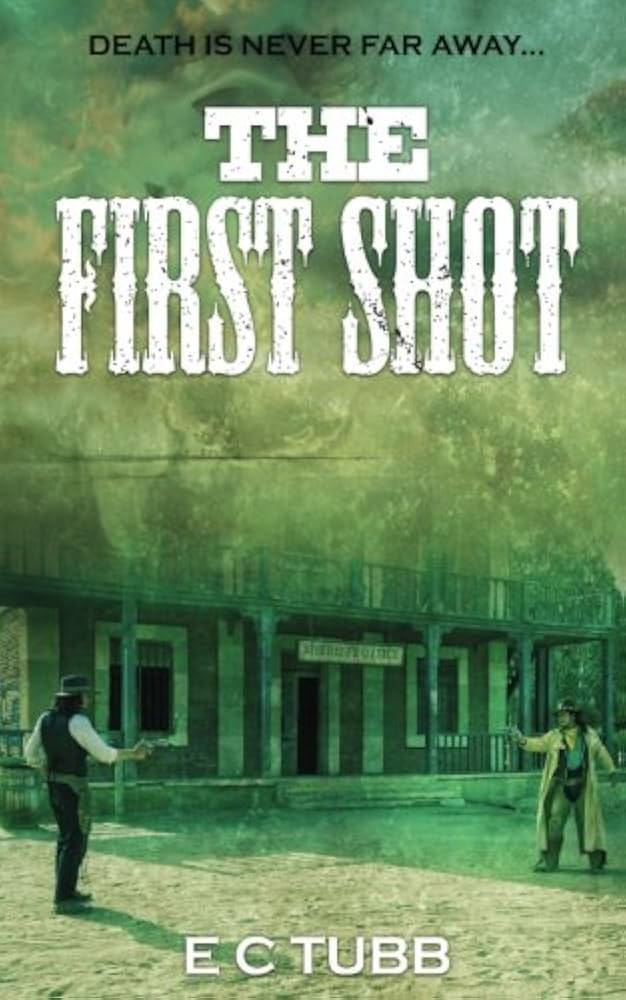
For once, the cover of a Tubb western has something to do with the story.  Even the title, The First Shot, fits.   The story is from 1957 and is 117 pages long.  A man returns from the Civil War, having fought for the losing south.  This is a familiar opening in most of Tubb's westerns.  He had been a p.o.w. for two years, and was quite sick when the war ended.  He heads home to his father's Texas ranch to find turmoil and misery, mostly due to the now valueless southern currency. He encounters neighbouring ranchers who accuse him of rustling cows, and they beat him badly.  With help from a few friends he sets out to set things right.  This is a good story, and well represents what most people think a "western" novel should be.  Once again Tubb treats the Indians with respect, and makes one of the bad guys a crooked government Indian agent.  There is a high stakes poker game, and a climactic shoot out at the very end.  A good story that would make a fine film.
 
I read the Kindle edition. 
 
Originally contracted for ten books, Malzberg's vigilante hero series made it to 14.  Detroit Massacre does take place in Detroit, though there is no massacre.  From 1975, the novel is 152 pages long.  Detroit was still humming in 1975, but one would never know it from this novel.  Hudson's was still downtown, and the Ren Cen complex was being built.  Obviously the author had never been there, as the city is so sketchily represented as to be laughable.  The absence of a massacre in Detroit (there are two murders, and a man dies in an explosion) left me scratching my head.  Who wrote the titles for these books?  Malzberg, as noted frequently in this blog, can get inside the head of a crazy person better than almost any other writer.  Burt Wulf is going mad, and is beginning to crack at the seams.  So is a Detroit police lieutenant, who totally goes off the deep end.  Heroin is being smuggled into Canada hidden inside new Cadillacs, but the perfect system gets disrupted when an assembly line worker spots a bag of heroin sitting in a half assembled car.  From there things go downhill rapidly.  Meanwhile back in New York Wulf is being held in solitary until the system can figure out what to do with him.  With help from his cop friend Williams he manages to escape and make his way to Detroit.  Wulf's method of cleaning up the distribution of heroin is to blow up the vast Cadillac assembly plant.  Go figure.  Not the best in the series, but still readable.  Three more books to go.

It has taken me almost a year, but I have finally completed the four Colonel Pyat books by Michael Moorcock.  I hope I am able to reread this complex but highly entertaining series of books all over again.  The Vengeance of Rome is from 2013, and is 638 pages long.  The 4th and final volume of the Colonel Pyat series is a truly remarkable achievement.  Moorcock has been able to take a complex and virtually untreatable subject--the history of the western world from the early 1900s to present day London, and make it read like a novel.  Which it is.  While the main characters are fictional, the events enwrapping theses characters are not.  Think of Woody Allen's Zelig film, where he was able to take his character and insert him into old newsreels to make it look like he was really there at the time.  Moorcock goes much deeper, though, taking 2000 pages to firmly insert Pyat into 20th Century history.  And by all indications, the century, especially the first half, was nothing but a series of unspeakable horrors, culminating in Hitler's rise to power and subsequent events.
The character of Pyat is difficult to describe.  He uses cocaine when available (though claims he is not addicted), is against Jews (in the end denies his own mother and his Jewishness), is an engineer who designs futuristic ideas, often dealing with flight, makes love to women and men (though he much prefers women, especially younger ones), and travels the world, getting into serious difficulty no matter where he happens to be.  Pyat is a marvel of a man, and I dare say he is "everyman," one who seems to embody not the worst nor the best of the male sex, but fits just about in the centre.  However, his lows are very low, but his highs are also remarkable.
The story continues where volume 3 left off.  Pyat is soon in Italy, and we are immersed in the world of Mussolini.  After his Rome adventures the setting moves to Germany in 1930, remaining there until just before WW II.  Pyat's one personal encounter with Hitler must go down as the most shocking scene in the entire series, and there have already been several doozies.  Pyat spends time in German prison camps before managing to finally get to England, his destination since volume 1.  Mrs. Cornelius continues to provide him with literature's weirdest sidekick.  The book's final scene, where Pyat denies he is Jewish (as he has already had to do hundreds of times in the story), seems to be a perfect ending to one of the greatest series of books ever written.  Really, it could not have ended any other way.  The books are definitely worth a reread, in perhaps five years or so.  Until then, Pyat's adventures in 20th C. history will never be forgotten.  Very highly recommended series, ending with perhaps the best book of the four.

The four previous novels continue my exploration of SF authors who were represented in the Avon/Equinox SF Rediscovery Series (see my entire blog, link in upper left).  After finishing up the Moorcock, which I split into two months of reading, I moved on to the next author in the incomparable Delphi Classics series.  Paul Kelver is the first serious novel of Jerome Jerome, and is from 1902.  It's a 400+ pager, but is quite fun to read.  It is semi-autobiographical.  The first part of the book (the book is divided into 2 books, each with 10 fairly long chapters) is seen from the perspective of a 7 year old boy, as his parents go through a crisis.  The scenes all take place in various parts of London.  Jerome cannot help but write with a wit that often leaves a reader laughing out loud, and this part of the book strongly reminded me of Kenneth Grahame's incomparable series of short stories called The Golden Age.  One quite tender scene has the young boy unwittingly come across Charles Dickens, sitting on a park bench, and their interaction is quite stirring and memorable.  A sort of hearty snideness pervades the novel, and often the humour becomes the main event.  One of the funniest and at the same time most uncomfortable scenes is when Paul gets drunk for the first time on sweet champagne.  He ends up proposing to a somewhat large young woman from his rooming house, and spends many pages afterwards trying to undo the damage.  However, before he can is dragged by his fiancee to meet "the family," a scene so unforgettable and so claustrophobic that it is a true wonder how Jerome manages to make us laugh all the way through it.  One of the most vivid scenes of any novel I have read.  Essentially, Paul wants to write serious drama, but is dragged by the collar, so to speak, into the world of comic writing.  His coming of age takes a rather long time to arrive, but along the way we get to share Paul's highs and lows, all of them entertaining and great fun to read about.  Filled with a large cast of wonderful secondary characters, this is a lengthy novel I am most happy to have rediscovered.

George MacDonald's The Portent is a ghost story first published in 1864.  Or rather a love story in which the two people have some type of deep psychic connection.  The opening scene and the conclusion are in Scotland, but the main part of the book takes place in a great house in the English countryside.  Working as a tutor to three children, Duncan Campbell encounters as pale young woman also living there.  However, she is kept closely watched by the Lord and Lady of the house, mostly for selfish reasons.  The girl gradually takes to Duncan and attends his classes, as she can neither read nor write.  The Lord and Lady seem to like things that way.  Hmmmm.  Suspicions are aroused.  The two become lovers and meet clandestinely in an old unused part of the house.  That is, until they are caught, and Duncan knocked unconscious and left in the woods.  The lovers become separated for about 8 years before Duncan finally makes an attempt to rescue her from her captors.  An easy read, the book has very short chapters and a short length.  Not great MacDonald, and not a great ghost story, it is still easily readable.

The Green Round is a supernatural story by Arthur Machen from 1933.  It was his fourth and final novel.  The tale is told in a somewhat confusing way, mirroring the problems that occur to a few different characters, but mostly to the main character.  Told both in his own words and by a therapist who treated him, it is a fascinating if often told story.  What makes this one so unusual is that the ghostly trickster causing the problem follows its victim home from his holiday beach location, where he had been causing problems already.  Once back in London, the entity begins to cause all sorts of nasty events to occur.  For the most part, the victim assumes he is imagining the presence and the events.  But the therapist checks his story and finds that witnesses confirm that events did happen.  Then what is causing them?  Why do some people see a dwarf accompanying the victim, and others do not?  Why does the victim eventually begin to see this dwarf?  As in any well told tale, there is no definite answer or conclusion to the mystery.  Is the victim's mind conjuring this demon and the events, or is some ghostly presence responsible.  There is a lot of discussion about dreams, along with the basic story.  Intelligent and quirky, this makes for an interesting read.

The Mystery of Philip Bennison's Death is a murder mystery from 1894 written by Richard Marsh.  Two older men, who have been best friends for many years, have a discussion about the Art of Murder one night.  Next morning one of them, Bennison, is dead.  It appears to be heart failure.  But this is a murder mystery, so we know better.  So does the surviving friend, Otway.  Despite the inquest proving no foul play, we and Otway are soon on the track of how Bennison died and why.  There is a butler who may have stayed out all night.  Did he do it?  Mystery readers know for certain that the butler did not do it.  Did Otway do it?  He walks in his sleep, and did dream of being in the room that night where the murder took place.  Was it the gambling nephew who always needed money from his uncle, who was none too fond of him?  Or perhaps it was his loving stepson, or even his more loving stepdaughter.  This is a good story that seems to have disappeared off the radar of this well known and still fairly popular author.  

Tony Hillerman's 1978 Navajo mystery novel Listening Woman contains most of the traits for which Hillerman has become justly well known.  Read many years ago, it was time for a reread.  This paperback has been on our shelf a very long time, even after we gave away the rest of Hillerman's works to my dad (who also got seriously hooked on them).  It is one of Hillerman's best novels.  Lieutenant Joe Leaphorn of the Navajo Police is all alone on this case, and before the end he has gone through enough physical hardships to last for several more novels.  Poor Joe!  The basic plot involves a radical band of Indians.  They have robbed a bank in Santa Fe, and now their new plot involves kidnapping 11 children (Scouts) and three adults, in retaliation for a similar number of Indians that were massacred by soldiers in the 1800s.  But the best part of the story isn't the story itself, but rather what we learn about Navajo religion and sacred rites.  One can learn much about the Navajo from reading Hillerman, as well as people from Zuni, the Hopi, and even the Utes.  The contrast between other tribes and the Navajo is quite startling at times.  A very fine read!
 
No cover art credit is given.
 
Harp of Burma is from 1966.  Written by Michio Takeyama, my translation is by H. Hibbett.  The story concerns a group of Japanese soldiers operating in Burma (now Myanmar) in 1945.  The story begins just before Japans surrenders, and continues until the men are sent back to Japan sometime afterwards.  The captain is a music graduate, and teaches his men how to sing.  They bond together strongly as a result.  One of the men, Mizushima, constructs a Burmese harp and learns to accompany the singing men.  Burma at the time was a very peaceful and strongly Buddhist nation that Japan wanted to conquer.  Once the men are placed in a temporary POW camp after Japan surrenders, they begin to reflect on their previous actions and those of their now defeated countrymen.  They begin to realize the errors of Japan's previous way of thinking and acting, and they wish to return and help rebuild their country.  But Mizushima had undergone a series of separate adventures from his troop, and decides to remain in Burma after the war and try to help bury the thousands of dead soldiers lying in forests and jungles.  This is a very moving account of a part of the war that is mostly unknown to people.  It also has a strong anti-war sentiment.  Highly recommended.  I have watched the film, but a very long time ago.  I will put it back in the queue for a near future viewing.

A scene from the book, by Motoichiro Takebe. 
 
Meanwhile back at the mystery book shelf...  The Man Who Went In Smoke is the second Martin Beck novel, written by Swedish husband and wife team Sjowall and Wahloo and published in 1969.  No matter where one reads about mystery novels, these ten books always come up as among the best ever written.  Martin Beck is no super detective, and sometimes doesn't have a clue what to do.  Though he has above average intelligence, he is often stymied in his investigations.  He usually works with a partner, but in this one he is alone a lot.  In this case, the disappearance of a successful magazine writer in Budapest doesn't interest him at all.  But off he goes, abandoning his wife and kids on holiday to accept the case.  While most of the story takes place during a hot and sunny summer spell in Budapest, the final denouement takes place back in a cold and rainy Sweden.  One of the interesting things I am noting as I begin this series is how much detail the writer includes, along with advancing the plot.  Rooms are described in detail, as are characters, some of whom have habits (such as drinking a lot of coffee each day) that help delineate the man.  And this seems, so far, to be a series that male readers might enjoy more than female ones.  The only lead female character in this book is a nymphomaniac.  The policeman's wives are using at home waiting for them to come home from work.  Though the books are slightly odd and different from most mystery stories, they don't yet come close to those written by Stanley Bennett Hough, who also wrote SF until the name Rex Gordon.  Still, I enjoy the European locations, as it doesn't take long to tire of New York or LA in mystery writing.  A fun read.
 
The Mugger is Ed McBain's 2nd 88th Precinct novel, from 1956.  Set in a fictional big city which is remarkably similar to New York, the title pretty much gives the plot of this one away.  However, when it appears that the mugger, who uses violence in his attacks on females, has killed a young woman at last, things heat up in the precinct.  In book one, a beat policeman got shot off-duty by a gang in a case of mistaken identity.  He makers an important appearance in this novel, actually solving the murder part of the mystery on his own.  this earns him a promotion, and if he appears in future novels, he will be detective 3rd class.  We get to see other detectives on this case, as the first detective from the previous book is on his honeymoon.  All in all a pretty decent read, though all the police detectives are men.  A female officer is used to try and snare the mugger.  The books were inspired, according to the author, by the Dragnet TV series, and often read much like one of those episodes.  This novel had a lot more humour in it, despite the seriousness of the cases.
 
Oscar The Detective, or Dudie Dunne, The Exquisite Detective wins this month's award for best book title.  Written by The Old Sleuth, it is from 1895.  Detective Oscar Dunne was born with very feminine good looks and mannerisms, which he often uses to advantage to catch the bad guys.   For beneath his effeminate exterior, he is a real tiger.  Hee hee hee, as Oscar would say.  His type of man was called a dudie or a chappie in the day, so there you go.  Ever read a story about such a detective before?  Me neither.  But it seems to work, as the bad guys fall one by one, and an innocent woman is saved from a life surrounded by criminals.  The story is mostly about a gang of thieves who robbed a noble household in Rome, Italy before escaping with the goods to New York.  It's great fun watching Dudie Dunne work his magic.  A most unique mystery novel.
 
Lastly, I finished a book I have been reading off and on for the past few months.  Tales From the Road is a collection of 33 short stories by various authors, all having something to do with a road trip.  Excerpts from Steinback, Kerouac, Hunter Thompson, and short stories by Ballard, Moorcock and many more kept my interest up throughout.  Quite a few of the stories are SF.  I will mention a few of my favourites.  A chapter from Thompson's The Rum Diaries really grabbed me, and I am now interested in reading more of his novel.  The chapter included here first appeared as Chapter 7 of the book with the same name.  It details a drunken adventure he had in Puerto Rico with some friends, an episode that reminded me of the song Sloop John B.  Michael Giorgio's "The Two Ton Turtle of Tattler's Terrace" is a fun little piece about a man's brief visit to a small mountain town following a stop to remove a turtle from the road.  Roxane Gay's "The Myth of Fingerprints" is a superior piece of writing that details the days before a woman's nervous breakdown.  It manages to be comical and dramatic in its 14 pages.  Brian Hodge wrote Miles To Go Before I Weep, about how a travelling salesman meets his lady, and the adventures that occur both before and after their unlikely meeting.  This one packs a few surprises, and somehow manages a happy ending.  "The Blood Like Milk" is a SF like no other, taking place in a pollution-filled future when gangs of roving and half-crazy drivers seek out moments of sunshine, to experience its effect on themselves and local fauna.  It is possibly the best story I have read that deals with ancient Mexican gods.  Coincidentally, the same Mexican god that messed up our third and final Mexican vacation, does its work on the hero of this story.  Quite unforgettable.  "That'll Be The Day" is a fantasy that gives an interesting look at Buddy Holly's final gig, before he died in a plane crash.  All in all a truly good collection of stories.  The Moorcock and Ballard stories are also both good, and I have read them and commented elsewhere.  They are "The Mountain" (Moorcock) and "The Mountain Dances" (Ballard).
 

See you in a month!

Mapman Mike


Saturday, 30 November 2024

November Reading Summary

A pretty normal month for reading, as astronomy nights were few and far between.  I read nine books, and parts of others.  Since I seem to have run out of works by Silverberg (at long last), my reading now begins each month with a pulp novel by Kenneth Bulmer, followed by one by E. C. Tubb.  Then comes Barry Malzberg, and, every other month, a novel by Michael Moorcock.  Following those four authors I am in free reading mode for the remainder of the month, choosing whatever I feel like reading.  I have a large pile of real books to get through, as well as literally hundreds of Kindle novels.  So here we go....
 
Rebel of Antares is from 1980, this continuing saga of Dray Prescott by Bulmer is 151 pages.  One of the things that can get tedious in a long series such as this (this is #24) is the types of predicament into which the hero can be placed.  A favourite with Bulmer (and Tubb) is the arena, where the Roman tradition of gladiatorial combat is intensified in sadism and cruelty.  Once again Dray finds himself in the arena, starting out yet once more at the bottom of the barrel.  This is the same arena where he escaped from in an earlier volume, and rescued Delia.  Though it does advance the plot somewhat, Dray still ends up in the dungeon, and he could have got there without all the trouble of fighting in the arena.  But what do I know?  I haven't published 24 books (not even one).
The action is high pitched, and often humourous, as when Dray must rescue a princess from a high tower.  This is a fantasy story trope, but it is quite updated and well done nonetheless.  It is a dark and stormy night, and Dray sneaks, climbs, and fights his way to the princess.  She has been a captive a long time, and has often fantasized about who her rescuer would be, and how it would be accomplished.  "I see they've give you books to read," comments Dray.  It goes without saying that the rescue does not exactly fulfill the dreams of the young lady, especially when Dray grabs her and they jump from the castle wall into a muddy moat.
This book actually comes to an ending, not a cliffhanger, though we know that Dray has more work to do.  He reconciles with one of his lost daughters, and his son gets married (to the rescued princess).  A happy ending!
 
The Kindle reissue usually features 4 novels.  The updated covers are a reprint of one of those volumes.  This was the cover of the original Rebel of Antares, by Ken Kelly.  Though the cover art may make it appear that females are helpless critters who need rescuing by manly men, more often than not the women in this series can take care of themselves quite nicely.
 
 From 1994 comes Zenya, a 157 page story, #11 of the on-going adventures of Earl Dumarest, a man searching for his birth planet, which happens to be Earth.  Earth was essentially a disaster area when Earl left it as a child stowaway, and since then has been searching for clues as to its location.  We are never told why he wishes to revisit a worn out, stripped down, ecologically dead world, but on he goes, adventure after adventure.  He's had many opportunities to settle down and enjoy a bit of life, but Earl would rather risk that life hopping from planet to planet, asking questions about Earth's location.  In this story, on the very last page, he gets some clues.  Big deal.  This has become a very thin thread trying to hold together a series of individual stories of adventure.  We visit two new worlds this time, with most of the action occurring on the 2nd planet.  Farming settlers appear to be having some problems with the primitive natives, and Earl gets himself hired to end the war that is ready to explode.
It's a good enough story, but not one of Tubb's best Dumarest ones.  Two female characters form a backdrop to the manly action scenes, but they are shallow and only interested in themselves.  In addition, they both have mental health issues.  So no great women characters here, I'm afraid.
 
From 1975 comes the 168 page sequel we've all been waiting for in Malzberg's vigilante crime series.  In Harlem Showdown (#10) Burt  Wulf returns to New York to figure out his next move.  He has taken out drug kingpin after kingpin, and lived to tell the tale.  Lying low in a Harlem rooming house, he begins to take on small time dealers, before realizing that his game is up.  He has done all that one man could ever hope to do.  Malzberg, in an afterword, says the same thing.  Events could not continue, as they just began to repeat themselves.  What to do next?  Williams, the ex-friend of Wulf, is back on the NYPD force, this time part of a special unit to find and capture Wulf.  They were once patrol car partners, until Wulf left the force.  Wulf finally figures out who killed his girlfriend, even though we've strongly suspected it from the start (no, it's not Williams).  He goes after the bad lieutenant cop, and the end comes soon afterwards.  I won't spoil the ending, but it's got to be either Williams or Wulf, right?  Wrong.  Mostly.  Let's just say that with four books remaining in the series, Wulf likely isn't going to die yet. I have a feeling I know what will happen to him, and it involves some kind of arrangement with the police.  There is a lot of introspection in this story, something that has been happening more and more in the series.  Malzberg is very good at writing about inner thinking, especially within crazy minds.  The series will continue for a bit longer, but likely with a different spin on things.
 
I also read 2/3rds of the last Colonel Pyat novel by Moorcock.   This has been a very rewarding and fun series to read.  I will report on it in the December reading summary.

Doctor In The Swim by Richard Gordon is from 1962, and makes for very light reading.  This book has been on my shelf for years, and is finally on its way to the charity shop.  In this episode the doctor gets engaged not once, but three times, twice to the same girl.  He also gets Sir Lancelot Spratt out of a a New York prison cell, helps his cousin to not get a divorce, and manages a troupe of delinquent girls at a holiday camp.  More or less in the tradition of Wodehouse, the novel can be read at one or two sittings.  Some very funny moments, and some not so much.  Not the finest of the series, by any means.
 
The Shaman's Game is a crime mystery novel by James D. Doss from 1998.  Influenced heavily by the Navajo mysteries of Tony Hillerman, Doss writes about a Ute reservation in southwestern Colorado.  I found the book at an antique store on our recent road trip, and picked it up along with a Hillerman novel.  The plot concerns strange deaths that occur during tribal Sun Dances at various reservations.  Rumour has it that a Native witch is responsible, making everyone nervous.  Officer Charlie Moon, a Ute who has some difficulty in believing old timers' tales about the power of witches, is about to learn some lessons.  The character of Moon himself is not a very interesting one, at least compared to the officers in Hillerman's novels.  He is quite bland, in fact, though efficient in his own way.
The most interesting characters seem to be two old women, Moon's Aunt Daisy, a shaman, and Popeye Woman.  Aunt Daisy provides a lot of the interest in this novel.  There are also two young women who are after Charlie Moon for a husband.  One of the things I enjoyed about Doss's writing style is his following up spoken dialogue with the inner thoughts of the speaker immediately afterwards.  A speaker might smile and say hello, but their inner thoughts carry a very different message.  I also like how he builds towards his climax, though perhaps it takes just a bit too long, especially after a very slow opening exposition.  The book is part of a series, the third volume.  I may look out for at least one more before passing final judgement.  I did like the book, and most of the characters, especially the women, were very well drawn.  The ending keeps on surprising, even after the alleged bad guy is caught.  The book, like Hillerman's novels, also offers a chance to learn a bit about Native American culture.  By the end of the novel, my thoughts were also turning towards the writing of M R James, a writer of ghost stories.


Next came a collection of ghost stories by M R James from 1919.  A Thin Ghost and Others contains five tales: The Residence at Westminster; The Diary of Mr Poynter; An Episode of Cathedral History; The Story of An Appearance and A Disappearance; and The Two Doctors.  All are quite good, though not equally spine tingling.  The Appearance/Disappearance one is probably the strangest tale of the set, involving a Punch and Judy show; the first tale is probably the scariest of the bunch, though I suppose it depends on what frightens a particular reader.  Always worth reading, James' style is sometimes mundane and matter of fact, though he can build up nicely to a suitably grim finale.

Original 1919 publication. 
 
Tony Hillerman novels are now quite expensive, considering that they are all reprints and require no further editing etc.  Even Kindle costs are quite high.  So I was pleased to find a bunch of his novels at an antique store in Moriarty NM on our recent road trip.  I took The First Eagle, a later work from 1998.  Having just read a copy cat novel by Doss, and not having read a Hillerman in many years (he has passed on and his daughter now writes the new ones), it was good to revisit the old days.  I think by chance I picked up a novel I hadn't read before, as I remembered nothing about this Navajo mystery.  As usual, two stories intertwine.  Joe Leaphorn, retired from the Navajo police force, takes on his first private investigation.  A woman is missing and he is asked to find her.  The second story sees a police officer killed in the line of duty, and acting lieutenant Jim Chee, who was Leaphorn's protege, is convinced he has arrested the write man.  But of course he hasn't.  Hillerman weaves his magic, taking us deep into Navajo landscape, this time in Arizona.  I can't say if this is one of his best novels, but it was really good.  I have one more sitting on my shelf, one I know I have read.  So I will read that one, and perhaps keep looking for more Hillerman on second hand shelves.  Hillerman teaches as well as entertains.  We learn much about traditional Navajo ways in most of his novels, and this one is no exception.  He also tackles the thorny problem of reservation cops having to respond alone to most calls, with backup often up to an hour away.  In First Eagle we also learn a bit about Hopi traditions.  And there is science, in the form of flea catching.  Bubonic plague is still a threat in the southwest, due to infected fleas that bite rodents, which then get into people's homes.  So there is a sprinkling of microbiology, too.  Highly recommended, even if you've never read one of his books before.
 
A recent used book purchase. 
 
Thanks to a 36 part lecture series on mystery writing and its long legacy, we have been jotting down several authors of interest.  The first of these I have explored is about the Swedish police detective Martin Beck.  The first book of a series is called Roseanna, from 1967.  The books were co-authored by Maj Sjowall and Per Whaloo, and are among the favourite mystery books of the lecturer.  Beck is a detective on the national police force, like the FBI in the US or Scotland Yard in the UK.  He is called in when local police don't have the resources to deal with a serious and unsolvable crime.  And this one really seems unsolvable.  A woman is murdered on board a tourist cruise boat and her body dumped overboard in the canal.  The body is found soon afterward during a dredging operation.  The book is a police procedural,f and we soon realize how difficult and how boring the job can be.  The body is found in July, soon after the murder, but it is not until after Christmas that the case finally gets resolved.  Sometimes the authors write with a grim and very dry humour.  Beck himself is a physical wreck; he smokes too much, he never eats properly or sleeps much, and is often sick.  He has no meaningful relationship with his wife and two young children.  He is away from home nearly all of the time, either in his Stockholm office or travelling to other towns to investigate leads.  I have a few problems with this first book, though overall it is a very engrossing story and generally very well crafted.  First all, Beck only seems to have one crime on his caseload, with all the time in the world to solve it.  He must be the envy of a lot of detectives.  Secondly, the climax of the story, while gut-wrenching, is hardly plausible.  On their way to catch the criminal in the act of murdering a decoy policewoman, on a quiet Sunday morning, they are suddenly involved in a massive car pileup, and all their doors won't open.  When they finally get out, they have to run the 650 yards to the scene.  This past is quite amusing, anyway, though so improbable as to be laughable in itself.  And it's quite inexplicable as to how the killer just manages to walk into the apartment, considering it has always been locked and chained up till now.  I will read the second book eventually.  We'll see if any of these quibbles get ironed out, or if they will repeat.  

I read the Kindle edition. 
 
Lastly comes another first book of a large detective series.  Ed McBain's 50+ book series about the 87th precinct takes place in a fictional city remarkably like NYC.  Whereas the Martin Beck novel was gritty and showed a realistic look at European crime solving, the 87th precinct novels are far grittier, and show a realistic look at American crime solving.  Cop Hater is from 1956, and McBain (real name Evan Hunter; before that he was Salvatore Albert Lombino) attempts to show the workings of a busy police precinct (district) when one of its detective is murdered, shot from behind when he was going to work.   A police procedural, there are virtually no clues at the beginning of the serial cop killer's rampage.  When all is said and done, three detectives are murdered.  However, the third, aware of the danger, manages to wound the perpetrator, and leave a few other clues behind before he dies.  Being 1956, the women are all wives of cops, so McBain, at least in the first novel, shows us a man's world, ruled by violence, bad jokes, and lots of cigarettes.  McBain/Hunter wrote the novel Blackboard Jungle, as well as the screenplay for Hitchcock's The Birds.  I purchased the first ten books in this series from Kindle for a bargain (less than 2$ per book).  So I will likely read the first ten, at least.  This recommendation comes from our television lecture series on great mystery writers.
 
I'm also chipping away at two large books, the fairy tale one by Joseph Jacobs, and a compilation of short stories edited by M. Jakubowski and M. Christian, called Tales From the Road.  It's a Mammoth Book, one of their series.  It includes chapters or stories by Moorcock, Ballard, and Kerouac, among others.  Some of the stories have been very disturbing.  More on this book when it is finished. 
 
Mapman Mike