Saturday, 2 October 2021

September Books Read

 I managed 9 books from my Avon/Equinox authors, and one from outside that project.

First up was Silverberg's A Time of Changes, a good story though perhaps overrated by its winning of the Hugo Award for 1971.  In a society where everyone thinks alike, and use of personal pronouns regarding oneself are prohibited, people (very few of them) must take a drug in order to experience thinking outside the box.  Since the drug is forbidden, as is the thinking it provokes, it is a dangerous pastime.  Silverberg wades into the "what is love?" question, and deals with it rather unsuccessfully.  I used to think such societies were too far fetched to be believable.  Now, they are found nearly everywhere in the world, especially in fundamentalist religious societies.  The story does make one think about things.

Next up was Piers Anthony's 2nd volume in his Bio Of A Space Tyranny series, called Mercenary.  While I have serious problems with the first book, I decided to try the 2nd one.  Nearly a bad mistake.  The overall story is okay, and makes for decent reading.  Until the chapter entitled "Rape."  It boggles the mind at what publishers will print if they think a work by a recognized name might sell copies.  If an unknown writer had sent this off to a publisher it likely would have gone straight to the reject pile.  At the very least, the rape chapter would have been excised or severely rewritten.  There is no real point to be made by Anthony by including this chapter, other than to point out to us that there really are women out there (in space) who want to be raped.  It's part of their culture, or something.

Next came Harry Harrison's final Eden book, called Return To Eden.  All of your favourite and least favourite characters are back, as Harrison strives to create a world made different by the lack of a huge meteor taking out the dinosaurs.  In his world, intelligent reptiles and prehistoric humans meet head on in a fight for survival of the fittest.  Though extremely well written and an absorbing story, I found myself wishing the series had not gone on so long.

Warrior of Scorpio is Bulmer's third entry in his nearly endless Dray Prescott series.  I am committed to reading the first five books, which form a subset within the 38 novels, but beyond that I make no promises.  Though good storytelling is present, Bulmer is simply riding the coat tails of Burroughs and H Rider Haggard, offering readers nothing new in the genre of big strong warrior on a hostile planet.  At least they are easy to read and pass by quickly.

Next up was E C Tubb's Twelve From Tomorrow, 12 short stories from the late 50s and early 60s.  The best stories are "Sense of Proportion," which Barry Malzberg totally ripped off for his novel called Revelations; "Greek Gift," which Twilight Zone ripped off for their episode called "To Serve Man;" and "Worm In The Woodwork," a novelette in the tradition of James Bond.  There is only one weak story in the collection.  In addition, "Last of the Morticians" is a pretty funny tale.

Jack Williamson continues to hit homes runs, this time with Lifeburst, a mid-80s novel that has a depth and scale encountered in the works of Iain M. Banks.  His concept of skywires coming down from satellites to the Earth is brilliant, and boggles the imagination.  Life in a small colony on an asteroid in the Oort Cloud is well handled, and the story features several alien races, including perhaps the scariest alien monster I have ever come across.  He even manages to give this deadly creature a sense of emotional depth.

The Dragon In The Sword completes Moorcock's 4-volume Eternal Champion series featuring John Daker.  One of the volumes is a totally magnificent graphic novel by Howard Chaykin, a favourite artists, based on a story by Moorcock.  In this final novel, which I awarded 4 stars, the champion is taxed to the max in his battle against Chaos.  One of the best ideas ever is regarding the ships that travel through shallow swamps, filled with people who spend their lives on them.  The three heroes that team up to defeat the enemy make a great trio, one female and two males.  Written several years after the earlier books, the more mature writing style helps a lot.

Next came Guernica Night by Malzberg, a short novel that probes a futuristic tendency for huge amounts of the population to commit suicide.  This one requires a second reading, at the least, as it contains many levels, and changes back and forth between three characters.  Though this is a strange novel and not a standard one by the author, it is easy to read, and what you take from it depends on your personal views and philosophy of life.  Any Malzberg is worth reading, but this is not top notch Malzberg.

Short stories by Blish rounded out my Avon/Equinox authors.  The Genius Heap focuses on artists, musicians, and those kinds of people.  they are sent off to a moon of Jupiter to live together under a grand experiment.  Only the experiment they are told about is not the real experiment.  Stories about creative types in SF are rare enough; this is a pretty good one.  Also wroth checking out is Tiger Ride.  Alien life forms can surprise, even after encountering thousands of them in my reading and movie watching.  This is one of the more ingenious creations by a SF writer, of a benign but extremely dangerous to humanity type of AI.  Good stuff!

My outside reading was Anne Hillerman's first novel, called Spider Woman's Daughter. Anne is the daughter of Tony, famous for his Navajo police novels taking place in New Mexico.  I have read all of his books, and now Anne has taken a turn at bringing Leaphorn and Chee back to life.  While treading carefully in her father's footsteps, Anne brings a female perspective to her story by focusing attention on female officer Bernie Manuelito.  It was a good read, though the ending was needlessly over dramatic.

Best cover of the month (though having very little to do with the story) goes to artist Karen Carr for Harry Harrison's Return To Eden.  Congratulations Karen!  To claim your prize, contact me here at Blogger.

This month's winner for best cover art is Karen Carr. 

In final book news, here is a list to date of Delphi complete works I have purchased for reading on Kindle.  I have already read several works from these collections, and am currently working on some short stories by Lord Dunsany.

 L. Frank Baum.
Edgar Rice Burroughs
Sir Richard Burton
James Branch Cabell
G.K. Chesterton 
Joseph Conrad
Lord Dunsany
William Hope Hodgson
George McDonald
Arthur Machen
William Morris
George Bernard Shaw
Jules Verne
H.G. Wells

At an average cost of about $3 Canadian for each volume, I am adding about one each week.  Yes, there are plenty of female authors on my wish list, too.

Mapman Mike


Friday, 1 October 2021

Backlog

 I am pretty far behind, and not just in my blogging.  Piano practice has almost come to a standstill, and even my reading program has slowed, but not stopped. So what's up?  All in good time.  First, turning the clock back to September 22nd, we had a very enjoyable Autumnal Equinox.  The latest heatwave broke exactly on that day, and it rained all day and was windy and cold.  And that meant we were able to have our first indoor wood fire of the season.  It's been several years since it's been cool enough to have a fire on Equinox.  What a treat!  Along with good food, some brew, and great music, we also read a bit of Tolkien.  We read The Cottage of Lost Play, from Lost Tales Book 1, as well as a poem of the same name.  The Cottage was Tolkien's initial solution to relating the tales of origin of his mythological world, and actually I'm surprised he dropped the idea, for it is a good one.

Anyway, I've never seen a season change over so fast, and exactly on the day.  First, two local images of late summer in our area.  Then I'll tell you of my first journey since Covid hit.

Amherstburg's Navy Yard Park, looking towards Lake Erie and a distant freighter at the mouth of the Detroit River.  It was a beautiful summer day in mid-September.

Lake Erie from Kingsville's Waterside Park, on a blustery late summer day. 

Last Friday (the 24th of September) I finally made my way to Sudbury, for my long delayed family visit.  It is pretty much an all day drive, nearly 500 miles NE of A'burg.  I left home around 9:40 am and arrived at around 6:30 pm.  Aside from gas and restroom stops, I made two scenery stops, one at a waterfall near Sudbury I had never visited before.  In Sudbury, living in one large building owned by my parents, is my brother Steve, my sister-in-law Lynne, my niece Emma-Lee (now 12), and my parents.  Mom and Dad live upstairs, my brother's family mid-level, and the lowest level is a guest bedroom (mine) and cozy bar.

Typical northern Ontario roadside scenery as one approaches Sudbury.

Just south of Sudbury, and well off the main road, is this lovely waterfall.  I spent about 20 minutes here, enjoying the cool northern air and the sound made by the water.


Part of the waterfall goes beneath this old single lane bridge. 

I had a good visit, with the weather keeping me indoors Friday night and Saturday.  It was cold, raining, and windy, so I was able to spend a lot of time with family.  Mom and Dad seem to be doing well, still managing 3 flights of stairs to get up to their apartment.  Dad's knee is bothering him, and he is currently awaiting an MRI scan and hopefully some treatment.  Other than that, everyone is fine.  Lynne works from home now since the pandemic, but Emma-Lee is back in school, starting Grade 7.  Steve works at the Ford dealer in Sudbury, at the service desk.  Saturday I visited Spacecraft Brewery, a cool place I had visited once before.  I ended up buying ten bottles/cans of beer, some made there, others from different breweries as far away as Toronto.  I also visited Beard's Bakery, a vegan cafe where all the baked goods can be eaten by the likes of me.  I got coffee and a scone to go.  I managed some reading Saturday due to the dismal weather, otherwise I would have been outside more.

Sunday the weather cleared up enough for me to take a short hike, accompanied by Emma-Lee.  Called the Rotary Park Trail, it led up to a lookout over New Sudbury and Junction Creek.  It was cold and grey, but perfect for hiking, and we had an enjoyable time.  It's the most time I've spent with my niece since ever I've known her.  She is a really nice person, extremely well brought up.  She chatted my ear off on the hike, but it was fun.

Rotary Park Trail, Sudbury.

It was still very early autumn, but a few leaves had changed already.

Junction Creek, from the overlook.
 
View from the lookout, partway up a pretty high mountain in Sudbury.

Mushrooms and moss captured our attention on the walk.

Emma-Lee prepares to take a photo of the mushrooms.
 
Emma-Lee on the rocks.

Young birch tree against the rocks.

Forest of young birch trees.
 
 
I drove home Monday morning.  With less traffic and fewer stops, I was home by 5:30 pm, only four days behind my reading and practicing.  But wait--it's astronomy time.  It was clear Monday night, but I was too tired from driving to pack up the scope and take a long drive out to my observing post.  But it was clear Tuesday, Wednesday, Thursday, and tonight, Friday.  I went out three nights in a row, having glorious observing sessions.  But tonight I begged off, needing some chill time.  During the day I wrote up my observing notes (I am still not finished), did some piano, and some reading.  With cloudy skies predicted for the next several nights, life should return to normal now.

If this actually happens, then I will post asap my September reading progress.  Stay tuned.

Mapman Mike


Sunday, 19 September 2021

September Weather Bliss

We here at the Homestead firmly believe that September is the finest month of weather of the year.  The warmth is still there, but far less intense than August.  Since moving down here and getting used to flowers still blooming well through October and into November, there have been few opportunities to fully enjoy the month.  Since most people return to school and jobs, the month is usually seen sideways, rather than straight on.  But with retirement comes time to enjoy many things once only glanced at sideways.  No excuses now.  Though it's still too hot to hike in New Mexico, unless you stay up around 9,000', in our part of Canada one couldn't ask for better weather.  We've been on a sunshine streak, too, though that should end tomorrow, along with some cooler breezes.  Even the family in Sudbury has been enjoying the month.

Speaking of Sudbury, I will soon be on my way there, my first trip since the pandemic began.  My last visit to the north was in early November, 2019.  I will experience a very different September there than here, though only 4 degrees of latitude separate us.  And New Mexico?  I have already given up two of my almost last years of good hiking to the pandemic.  Oddly enough, though, I have never been in better overall physical condition.  Over 15 months of daily exercise now, and counting.  Weird.  With about four weeks to prep for mountains, I can be ready to climb again.  And Detroit?  It's been 20 months since my last visit.  We should be hearing soon as to when or if the border will reopen to Canadians.  Last we heard it was closed till the 21st.  Will that be extended?

In music news, I have finally parted with my pandemic piano program, and am fully engaged in a new one.  I got to perform four times, and though I wish more people could have heard the pieces, my brain desperately needs new repertoire to attack.  Bach, Beethoven, Mendelssohn, Chopin, Schubert, and Joplin are on the program.  Most of the pieces should be decent by Christmas, with perhaps a late winter concert.

In film news, Deb is finishing up her episode of Yorick's undersea adventure, a project that was interrupted when her mom moved down to this area.  It is likely her most elaborate Yorick episode to date, filled with stunning graphics and the usual hilarious skull's humour.  Several of her films continue to be shown at festivals around the globe, though she has been finding that it is becoming harder and harder to get accepted.  Some festivals that used to get a few hundred entries now get several thousand.

Turning to art, most gallery goers know of Canaletto and his detailed paintings of Venice.  Far fewer (me included) know much about his prints, but these open up another whole world of adventurous seeing.  We'll look at two eventually (one today), and one by Bellotto.  Here is the first one.

View of a Town on a River Bank, between 1735-1746.  Canaletto, Italian, 1697-1768.  Etching printed with black ink on laid paper, 12" x 17".  Collection Detroit Institute of Arts.
 
There are several noteworthy features of this finely detailed landscape print, most of them showing up better in close up study.  For instance, the reflections on the water, the finely portrayed shadows in the background, and the solitary foreground tree, reminiscent of Dutch landscapes by painters such as Ruisdael.  Time to zoom in...

Detail of right side.  Note the shadow of the waterwheel across the river, as well as the shadow of the railing to its right.  Closer view coming up.
 
Incredible depiction of shadows, close up.
 
Detail showing what I call the Ruisdael Tree!  This detail also shows the reflections really well.

Final detail.  Note the water birds on the left.
  
 
Equinox is approaching!  And a full moon is not far ahead of it.  Exciting times never stop around here.
 
Mapman Mike


Friday, 17 September 2021

A Farewell to Mogollon

 Mogi's ashes were returned yesterday, and he will spend some time indoors with us before being scattered outside in the garden.  His name comes from a ghost town in New Mexico, which is named after a mountain range Mogollon (Mogoyawn) Mountains).  The mountains are in turn named after a prehistoric native culture, with some of the most famous and interesting pottery in the world.

Mogi started out as a problem for us.  He appeared one summer day in our backyard, trying to catch birds at our back feeder.  I would go out and chase him away, but he always returned.  Then we were in New Mexico, camping and hiking in the Mogollon Mountains, and visiting the ghost town of Mogollon when we decided to trap him and keep him.  Upon our return from that journey the cage trap was baited with cat food, and it didn't take long before we had trapped a live and fairly wild pussy cat.

An early image of Mogollon, crouching beneath the harpsichord.  Gustav pretends nonchalance, but is watching him closely. 

    Once trapped (he was an adult) it was off to the vet for some necessary surgery and a check up.  A healthy cat was returned to us a few days later.  We already had Ferdinand and Gustav, so adding a third cat to the mix was going to be interesting.  Of course we named him Mogollon, Mogi for short.  He had been delivered to the vet in the cage trap, and returned to us in the same way.  He spent several days in there before we released him.  Deb took a few days off work, and spent time reading to him, and introducing him to the stick of love.  The stick was about 12-14" long, and she would gently approach him with it through the bars and scratch his head.  He quickly learned to like it and accept it.  Next came her hand, and before too long he was out and about the house, much to the amusement of the other two cats.

A major milestone, as Mogi climbs aboard Deb for the first time.  His favourite thing was to be scratched under his chin.  I was with him and doing just that when the vet put him into his final sleep.

Feeding time at the cat exhibit.  Mogi in front, Ferdie behind him, and Gustav acting nonchalant again.
 
After dinner nap time. 

Unfortunately, Mogi and Gustav just couldn't get along.  Mogi had to move into the back bedroom, and was only allowed out when we were there to supervise.  He had access to a cat bed up on a window looking out into the backyard, and enjoyed it a lot when the window was opened (with a screen).  Ferdie got along fine with both cats.  Once Ferdie and Gustav were gone, Mogi ruled the roost and finally came out of his room full time, though it wasn't for very long.  Gustav passed on last October, so Mogi got a little more than ten months of total freedom.  And of course last February was his eye removal surgery.  Still, we did our best to totally spoil him in the little time we had remaining.

Mogi loved to listen to music, harpsichord and strings being his favourite.  He would hobble up onto the couch and lay down whenever it was time to listen (usually around 6 pm for some Bach, and around 9:30 pm for various composers, and whenever I was practicing keyboard).  He loved the Scarlatti harpsichord pieces I played, as well as one of the Brahms Waltzes.  He also loved assisting me at the work table whenever I did astronomy notes or map studies.  Sliding him off the books and maps became a game with us, a game that he usually won.  And returning to the stick of love for a moment, whenever he was on the table with me I would use a pencil to rub his forehead, which he still loved.  Brushing him also brought out loud purrs, and he was brushed often.  Even on our final day together, before going to the vet, he was brushed and came through with a good, solid purr.

Mogi, being adorable and annoying at the same time. 

Ferdinand and Mogi enjoying a long winter's nap.  Deb painted our table years before, oddly enough with Mogollon designs. 

Mogi and Gustav, while looking relaxed and calm, were under supervision.  They could be very aggressive to one another.

Sunshine duet.
 
One of the last images of Mogi, eyeless since his February surgery.  He came through the surgery just fine.
 

In the end Mogi succumbed (like Gustav) to a mystery virusWhen a cat is no longer interested in food, then the end is very near.  Deb tried everything possible, but each meal was a struggle, and each time he ate less and less.  His arthritis was terrible, but under pain management with drugs.  But without being able to mix the meds in his food any longer, we had to begin forcing it into his mouth.  The doc examined him, and said it was probably time.  And it probably was, but that fact does not make parting any easier.

So long, Mogollon, the last of five cat companions we have lived with and loved dearly.  Thanks for all the entertaining and fun times.  You were a cherished member of the household, and never to be forgotten.  The house seems so quiet and empty...

 
Mogollon (joined us in 2007-2021).

Mapman Mike


Saturday, 11 September 2021

Green Leaves of Summer

A time to be reaping 
A time to be sowing
A time just for living
 A place for to die
 
Twas so good to be young then
To be close to the earth
Now the green leaves of summer
Are calling me home. 
 
Dimitri Tiomkin wrote the haunting melody; Paul Webster the lyrics.  The song was written for the movie The Alamo, and was nominated for an Oscar.  I've known the song since I was seven, and it has always moved me. The Brothers Four sang it for their entire career, and it was always welcomed by audiences. 

It's late summer here at the Homestead, and the green leaves of summer are enjoying their last few weeks on their trees.  While I always look forward to autumn, with chilly nights and mornings, different outdoor smells, wood fires in the fireplace, and the turning of leaves, it's always hard to say goodbye to summer.  Even one that baked us with its heat and soaked us with humidity.  Paradise is lost for another year.  With the arrival of Equinox in just over 10 days, the approach of winter is now unstoppable.

Late summer seems a fitting time to be melancholy, and I think I always have been that way then.  For most of my life it meant going back to school, either as a student for some 20 plus years, or as a teacher for nearly 40 years.  We would often be returning from New Mexico in late August or early September, knowing we were faced with an abrupt lifestyle change: paradise lost, yet again.  How many times can one lose his grip on paradise and still remain sane?
 
Of course retirement is like one long, continuous paradise, given financial security and decent health, along with enough interests to last more than ten lifetimes.  But the ingrained feelings of what autumn brings never go away.  It still seems like the end of something beautiful, and the start of something less so.
 
I will be posting less frequently for the near future.  Whether through laziness or having nothing much to really say I cannot tell.  I think I do have things to say, but it is taking time to formulate the words and thoughts.  Thinking back on the highest and lowest points of one's lifetime is a bit of a chore, but I am slowly edging towards the challenge.  Hopefully readers will check back once or twice a month to see how my progress is proceeding, or if it actually is.  A memorial page to Mogi the cat is still forthcoming soon; I am not yet emotionally ready for that task.

In the meantime, here is another wonderful print from the DIA.  This rock and its habitations look a lot like paradise to me.  Paradise is a fantasy, of course, even for the rich and famous.  But writers and artists can do a good job of sometimes convincing us otherwise.
 
Le grande rocher, ca. 1630.  Israel Henriet, French ca. 1590-1661.  Etching printed in black ink on laid paper.  4.5" x 9.75".  Collection Detroit Institute of Arts.
 
Detail of right side, bottom.
 
Detail of the rock.

Further detail of above detail.
 
 
Mapman Mike


Thursday, 2 September 2021

Odds and a Few Ends

 It's nearly unbelievable how much we put out for garbage collection tonight.  Most of it was cat related, as we got rid of old and battered cat trees, scratching posts, stairs, etc.  We brought a lot of unused food to Erie Wildlife, just up the road, but there was still a huge amount of other things to fit into large green bags.  We usually put out two bags each week, so the collectors will be unpleasantly surprised when they pass our house tomorrow morning.

I'm happy to say that just as August came to an end, so did our interminable heat wave, with its high humidity.  Tonight the sky is very clear, it is cool, and the humidity has vanished.  Thanks to a strong push of northern air, we were spared any effects from Ida, which recently devastated New Orleans, and even New York.  Below is an image I took from a weather map last Saturday, just before it hit New Orleans.  That is one very scary picture.

Image from last Saturday, as Ida is about to ruin New Orleans (just above the eye). 

In August we had 18 days with temps at 30 C or above, 4 that reached 29 C, and a few others at 28.  While that is not especially hot for this area, that's only half the story, as the humidity levels were so high.  August ended up being hotter and more humid than July, which is unusual.  So far, September looks great.  In fact, yard work has recommenced, and the next major weeding event is currently underway.

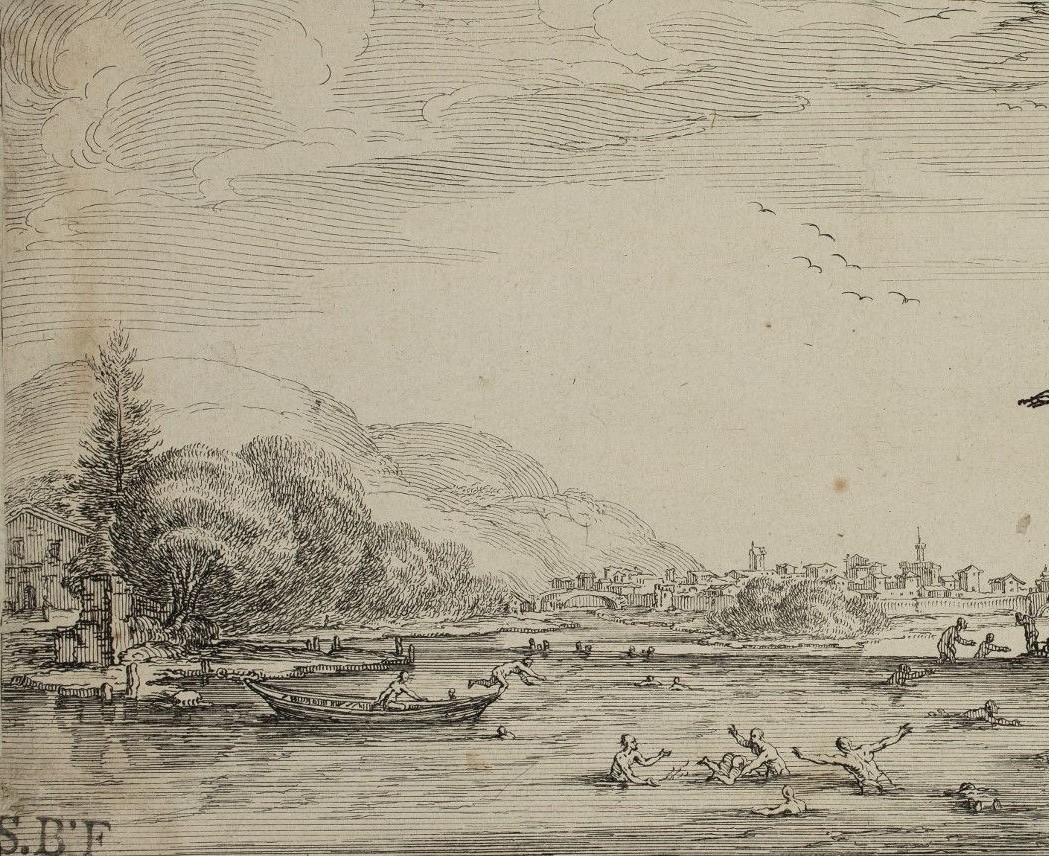
Now for a brief look at a landscape print from the DIA.  I have been having daily flashbacks to our camp on Lake Penage, west of Sudbury.  From the age of 8 or 9, I spent all my summers there, including several after Deb and I had moved to Windsor, gone through university, and got teaching jobs.  So, swimming in a clear, cool lake was not only part of my childhood, but continued well into adulthood.  This was also the location of some of my best and most memorable astronomy nights, despite bugs, wandering bears, skunks, and other various unwelcome night visitors.  Anyway, this image of people swimming caught my eye, and I wish I was one of them today.

The Bathers, ca. 1630 from a series called Various Italian Landscapes.  Jacques Callot, French, 1592-1635.  Etching printed in black ink.  4 5/8" x 9 3/4".  Collection Detroit Institute of Arts.

Detail of right side.

Detail of left side.

Detail of central area. 

We are currently watching a 3 1/4 hour documentary on Marcello Mastroianni, an autobiographical film starring Marcello, as he relates anecdotes and pearls of wisdom gleaned from a lifetime of movie making.  Loaded with film clips and interviews in various natural and indoor settings, so far it is a really enjoyable diversion.  Called I Remember, in one scene he talks about paradise, and how we long for the happy days of our youth.  This certainly fits with my Lake Penage mood these days.  But then he goes on to say that lost paradise is not the only paradise, that there are future ones still awaiting, especially if you are a traveller.  A nice thought, especially if someday we can actually travel safely again.

And last (and probably least) here is a photo of Mr. Piano guy in action.  A shout out to Randy for stopping by to listen to the program, and for the photo.

Maestro Mapman at the keyboard.
 

Mapman Mike


Wednesday, 1 September 2021

August Reads

 Ten books by Avon/Equinox SF Rediscovery authors, and one by a non-related author.  So, in other words, a pretty normal month.  In addition, I continue to plug away at Swafford's Beethoven biography.  However, I am now down to only 9 remaining authors, as I finished up works by J. G. Ballard last month.  Next to be finished will likely be James Blish, in about three months.  So, I am getting towards the beginning of the end of my project, which turned out to be much larger than first anticipated.  I know I will be skipping out on huge numbers of fantasy books by Piers Anthony, his moneymakers, as he calls them.  Most of them are pure garbage.  But let's get started on August's offerings.

Speaking of garbage, I hit two clunkers in a row right off the bat.  First up for August was Son of Man by Robert Silverberg, 212 pages of sheer pain and agony for readers.  Think of the worst kind of creative writing from the early 70s you can imagine, and then add several magnitudes of unpleasantness, and you have a very bad book.  However, this one was reprinted as recently as 2011.  Why?  Are people actually fooled by this kind of crap, and think they are reading some kind of literature?  Usually with his newer reprints Silverberg gives an introduction and talks about the birth of the novel in question.  I have an old print of it, without any explanations.  I would truly hate to read anything that Silverberg has to say in defense of this story.  The book went directly from my bedside to the recycle bin when I was done.

And the same with Piers Anthony's Firefly, a horror novel with monster that is filled with endless amounts of graphic and mostly unnecessary sex, along with a main character that tells endless and very long stories right in the middle of a chapter that might have actually gone somewhere before being interrupted.  Books like this one make me feel so sad for those writers who write much better stories and never find a publisher their entire life, while someone like Anthony can seemingly get anything published that he writes.  This one is seriously bad news, and I ended up throwing it in the garbage can rather than recycling it, in case someone sorting the material grabbed the book and decided to read it themselves.  It's a horror novel all right, though perhaps not in the manner intended by its author.

Thirdly, along came Harry Harrison to set things right again, as he usually does.  I've had very few misfires from this author, and I love his storytelling.  The Stainless Steel Rat Gets Drafted deals with several of Harrison's favourite themes; sending up the military, especially boot camp, and taking on small dictators.  This is the 2nd book in the series dealing with the youthful adventures of Jim deGriz, having already written several about the adult Jim.  All the Rat books are very, very funny, and usually contain more truth about things than almost any serious novel by other authors.

Next came The Suns Of Scorpio, the 2nd novel in the huge Dray Prescott series by Kenneth Bulmer.  They seem to come in groups of five, so I am committed to reading at least the first five books.  It is an hommage to Edgar Rice Burroughs and H. Rider Haggard, among others.  They can be classed as pulp adventure.  Though the second story wasn't too bad a read, it had a truly terrible ending, which really spoiled things for me.  With a better ending this might have been a worthwhile few hours of reading.  The planet of Scorpio is enormous, and we seem to spend time each new novel in completely different parts of it, which can be not only tedious, but leaves us with little sense of place or orientation.

A Scattering of Stardust  contains 7 short stories and a novelette by E. C. Tubb.  All of them are solid stories, very original, and easy to read.  By far the best of the batch is called "Little Girl Lost," about an important government scientist who stops working on his special project when his young daughter is killed in a hit and run accident.  An agent is sent to try and get the man working again.  A devastating ending comes as quite a surprise.

Jack Williamson continues to hit home runs, this time with Manseed, from 1982.  In all the SF I've read over the past 6+ years, very few people have a workable plan to get humans into deep space in other star systems.  Jack has one of the most brilliant schemes, and one that might have a chance at actually working.  Seed a thousand tiny ships or more, and send them out with humanistic robots and a very smart computer, along with human DNA that can be reconstructed upon arrival upon a successful candidate planet.  Equip each ship with a Defender, a robot with some human characteristics that can assist in times of trouble.  The story is about one such Defender on one such seed ship, and the story is not only gripping and intense, but is actually believable.  In addition, its cover art wins this month's award for best art.

 
Cover art by Rick Sternback, winning my Cover of the Month for August.  

More Sword and Sorcery by Michael Moorcock was next.  Phoenix In Obsidian is Book 2 in the Eternal Champion sequence, starring Erekose (as Ulric) in an Arctic adventure that I quite enjoyed.  Lots of bad people, lots of good people, and the two never seem to mix well together.  The plot continually moves along, and the adventure is quite a good one.  The book ends with a definite cadence, though left open for more adventures, which, thankfully, did occur.
 
The last of Ballard's short fiction was next, with several highlights.  News From The Sun, Memories of The Space Age, Report On An Unidentified Space Station, The Secret History of WW3, The Enormous Space, and The Largest Theme Park In The World (about a United Europe) are all outstanding, and often times darkly funny.  I really don't know what I would do if I had to choose between Ballard's many novels and his shorter fiction.  Luckily I have both in my collection, and I consider them both indispensable.  He is an author I will return to frequently, and continue recommending to friends.  There is one novella that I can't seem to find, but I will continue my search until I do.

Underlay by Malzberg is his second dealing with horse racing and betting.  This one is very funny, as a man who owes money to the mafia is given a job to do to make things even.  The job involves digging up a body buried on the track, and hilariously involves a cello case.  The novel is not SF, but fans of Malzberg will not want to miss this one.  There are a goodly number of non-SF books that these 24 Avon authors wrote, so I am also getting a healthy dose of literature mixed in with my Rediscovery project.  This is one of those.

Last but never least came a story by James Blish I had never heard of before.  Get Out Of My Sky is from 1957, is barely longer than a novella, and concerns a diplomat that is given a deadline to make peace with a nearby planet, or else both worlds face total nuclear destruction.  It could easily have been written as non SF, as the story deals more with human stupidity than anything else, though an ESP angle adds a lot to the story.
I had time for one non-related work, and I finally picked up an Iain Banks novel that has been sitting on my shelf for many years.  At nearly 400 pages, The Steep Approach To Garbadale is a really good novel, and I kept turning pages for four days until it was done.  The last part of the book helped keep me sane whilst we dealt with the aftermath of euthanasia for our last kitty cat in the house.  There are no cats in the story, but lots of interesting people, and plenty of wild Scottish landscape.  There are still several Banks novels that I have not yet acquired, so I am looking forward to more of his writing soon.  This one is about a rich family, famous for inventing and marketing the board game Empire.  The story is focussed on Alban, and his incestuous relationship with a favourite female cousin (Cuz cuz, sweet cuz).  It's a pretty straight forward novel, without violence and very little sex, and I really enjoyed reading it.

Mapman Mike