Showing posts with label Marcello Mastroianni. Show all posts

Saturday, 7 September 2024

Fellini and Sorrentino: A Top Knotch Double Bill

 I am set to have a 4th night out with the telescope tonight.  As usual I am rather excited about it.  Another late night, though this should be the last, as next month the sun will setting even earlier than now.
 
We managed our first hill climb workout today at Malden Hill Park in Windsor.  5 weeks of local training, then one week of hiking as we drive west, then the big stuff for week 6.  Rather excited about that, too.
 
My last surviving uncle passed away this week.  Uncle Bill gave me my first high-paying job as a teenager, and I learned to drive 3-ton trucks towing trailers, too.  He owned a construction equipment rental company.  He and my dad built camps together on adjoining lots at Lake Penage when I was 9 or 10.  Bill was a big guy, and always moving, never liking to sit still.  He was a pretty amazing man, and I'm proud to have had him as my uncle.  He chose assisted dying, as his Alzheimer's condition was worsening by the day.  He passed away surrounded by his three sons.  Bon Voyage, Uncle Bill!!  His ashes are to be scattered at Lake Penage.
 
A photo of Uncle Bill from long ago, likely snoozing after a Thanksgiving or Christmas family dinner. A rare quiet moment for him.
 
In film news, Fellini's La Dolce Vita has always been on my top ten list since I first saw it many years ago.  The character of Marcello is a fascinating one.  On the surface he is a womanizer of the worst kind, and it's almost painful seeing him lusting after Anita Ekberg as she casually and coolly keeps him at bay.  Sending him out to find milk for a kitten in the late hours of a Roman night is the final straw.  Marcello is a journalist who is always threatening to write a novel, but never manages to get around to it.  He has deep feelings, but has no one to express them to, or talk about with.  He is saddled with a neurotic, shallow, and overly motherly girlfriend, and has no close friends in whom to confide.  The movie charts his rapid decline into mid-life chaos.  By the end of the movie he has reached the bottom, with nowhere else to sink.  He has chances at redeeming himself, but they never pan out.  His best chance is a fellow writer and intellectual.  When they meet up one night Marcello is invited to a get together at the writer's home.  The scene contrasts sharply with the usual parties that Marcello attends.  He is impressed with the man, and wants to talk more with him.  They both agree that this would be a good thing.  But when the writer kills himself and his two angelic children, Marcello is shattered, and there is no turning back from self destruction for him afterwards.  He meets with his father and wants to spend time with him and talk, but his father never had time for him and his Rome visit proves no exception.  Again Marcello is left alone.  He has one casual girlfriend that he thinks he could make a serious relationship with.  She leads him on one night, but quickly abandons him for a quickie with another man at the party.  Poor Marcello.  Then there is the angel from Perugia, a young girl who works at a cafe on the beach somewhere.  He tells her she looks like an angel from a Renaissance painting, and she does.  In the final scene she tries to communicate with him, explaining who she is and miming a typist, to ask him how his book is coming.  But he is far past the point of being able to hear angels, even if they are right in front of him.  And so we have a very depressing ending.  
 
Now showing on Criterion.
 
Or do we?  Just suppose that he has hit bottom, and that sometime afterwards he manages to climb out of his alcoholic haze long enough to write a very good short novel.  The plausibility of this might not have occurred to Fellini, but it just might have been a subconscious idea with Paolo Sorrentino, the director of The Great Beauty.  The film won the 2013 Oscar for best foreign film, and is also on my top ten list.  This is our third viewing, and it becomes more and more spellbinding the more we watch.  The character of Jep could be Marcello, as he celebrates his 65th birthday in Italian party style.  Jep had one successful novel 30 years ago, but has not written another one.  He is a journalist that covers art openings and events in Rome.  The film is sheer poetry from beginning to end, with possibly the best musical score ever added to film.  Many of the musicians appear in the film performing the music.  Like Dolce Vita, this is a film about vignettes, vignettes of great beauty.  Rome in 1960 and in 2013 are very different places, but Jep had adapted well.  He has the most envious flat in Rome, a host of friends though none terribly close.  There are moments of comedy along with the poetry, and moments filled with deep meaning.  Jep as an older Marcello makes seeing both pictures back to back essential to understand the relationship.  Of course Sorrentino, like most Italian directors, owes a huge debt to Fellini, and must feel him looking over his shoulder all of the time.  Whether the director made Jep into an older Marcello consciously or not, it is hard to deny the connection.  Though both movies stand perfectly alone as major masterpieces of cinema, when combined into one longer epic, the effect on viewers becomes transcendental.  Deliriously so.
 
Now showing on Criterion.
 
Mapman Mike

Thursday, 5 September 2024

Out Standing In My Field

Yes, it's astronomy season again.  Reading and sleeping have gone by the wayside.  This past week saw 5 clear nights in a row.  I was able to use three of them, as I need a day in between to recover from late nights.  Also, it is a 50 minute drive each way, which can be tiring.  But I have satellite radio and usually listen to NPR, CBC, or BBC World, so the time passes relatively quickly.  I might snag one more night before the moon is too bright.  Although we have a clubhouse and observatory slightly closer to home, the light pollution is so bad there now that I seldom even consider going there.  Instead, I park my self between two giant windmills on a narrow dirt road amidst soybean fields.  When harvest comes around I have to scoot elsewhere, or be blinded by combine lights.  No one has ever bothered me out there, not even the coyotes that often howl as they pass by.  I recently cleaned the mirror and reset it in its casing.  It made a huge difference this week to my observing program, too.  The mirror eventually gets coated by dust and loses some of its ability to gather light, so periodic cleaning is necessary.
 
As I said above, my reading time goes out the window during a run of clear nights like this.  At night I am under the stars, and my afternoon reading time is usually spent napping.  So I am still reading the first book, a non fiction by Silverberg. 
 
In other news, film festival weekend has arrived, and is now being spread over two weekends.  As things work out I get five choices in a row.  We began with a strange little 1960 Italian film starring Marcello called Il bell'Antonio, about a handsome man who attracts women to him.  He thinks he will never marry until he sees a photo of his supposed intended, played by Claudia Cardinale (21 years old in the picture).  He falls madly in love for the first time in his life and the wedding takes place.  However, because he is really in love with her, he is unable to consummate the marriage.  No problems with flirts and whores and even the maid, but not his wife.  This is really an oddball film, attacking society, the church, and marriage itself.  To Marcello, making love to his young wife would be like making it with a real angel.  He is unable to get past his sexual block when with her.  Of course annulment comes soon afterwards, and he is ridiculed.  There are several lighter moments, too, and the film was shot mostly in Sicily.  Well worth a look, especially the restored version.
 
Now showing on Criterion. 
 
One of the house rules for film selection is that at least one choice must come from the "leaving soon" selection on either Mubi or Criterion.  I chose a 1943 comedy directed by George Stevens called The More The Merrier, starring Joel McCrea, Jean Arthur, and Charles Coburn.  Not only is there a shortage of men in wartime Washington, D.C., but a critical shortage of housing, too.  The film has a lot of fun with both shortages when Jean Arthur sublets a bedroom in her apartment.  Watch how Coburn walks past the long line of people waiting outside to interview for the room at 5 pm, and takes the place for himself.  Today, exactly the same gag could be done with people staring at their phones as they wait; in 1943 they are all standing there reading their newspapers.  This is one of many funny gags.  Coburn's missing pants provide another.  Coburn then ends up letting half of his bedroom to McCrea.  Quite a fun picture.
 
Leaving Criterion Sept. 30th. 
 
Lastly came out first viewing of Blow Up in five or six years.  Criterion just got it, along with La Dolce Vita (see next blog).  Antonioni created a cultural icon with his 1966 film, still one of the best looks at swinging London ever put on film.  Though the main story about a photographer that unwittingly captures a murder on film is still the central element, there are so many distractive scenes and sidelines that one always discovers something new.  Such scenes include, but are not limited to, the visit to the old pawnshop and the purchase of a giant propeller, the sexually playful scenes with the young girls who want to be models (Jane Birkin is the blonde; she was 20 but could easily pass for 16), and the brilliant Yardbirds club scene.  These all contribute hugely to the overall effect of the film, though not directly involved in the plot.  Because of being over budget many scenes relating to the plot and its explanation were left out.  Thank goodness.  The film is a masterpiece as it stands.  One of my favourite films of all time.  Can you hear the tennis ball at the very end of the film?
 
Now showing on Criterion in a beautiful restored print. 
 
Mapman Mike


Friday, 16 February 2024

Solaris, Take 2

The most recent version of Solaris is from 2002, directed by Steven Soderbergh.  Though it has a lot going for it, the film ends up by disappointing SF viewers.  The sets are great, the actors are good, and the music is excellent.  But instead of telling a story about a sentient ocean planet, we get a Valentine's Day love story with an unrealistic happy ending that left me scratching my head.  Was this film even a science fiction movie?  Barely.  Mostly it was about a man who made a terrible mistake, and after making the same mistake again finally gets it right.  A bit like Groundhog Day.  We learn nothing much about human ability to withstand aliens meddling with our minds.  We see nothing to convince us that the main character is a brilliant analyst/shrink.  One would think he might use some of his knowledge and experience to try to get at the bottom of this mystery.  Just what is happening?  Why is it happening.  Is there any way to communicate with the alien intelligence?  Nope.  We learn nothing.  Admittedly I did not find too much to praise in the Tarkovsky version, either (and he is one of my favourite directors).  Even Lem, the author, says that neither film gets the heart of what his novel is about.  Though I have not read the novel, I am about to.  It will be discussed here during my end of the month reading summary.  So please come back for more.
 
We know it's a SF film because George Clooney is wearing a space helmet. 
It is leaving Criterion Feb. 29th.
 
That was Deb's leaving soon choice.  I would have chosen it if she hadn't.  Her main choice was quite a different kind of film.  La Antena is an Argentinian film from 2007.  It is constructed like a 1920s German fantasy film, and is mostly silent and in b & w.  It mixes avant garde technique with a unique story telling method, and it comes off really well.  There is a lot of humour in this tale of a city whose people have lost their voice, and are about to lose words, too.  The evil man who wants to take over the world (the plot has its weak points at times) is a TV producer.  The visual effects are great fun to watch, even as the story plods along to its inevitable conclusion.  The cinematic cleverness includes using the silent screen subtitles as integral to the action within a scene.  This was the first film screened by Mubi when it began screening films in 2007.  It got off to a very good start.  Highly recommended.

A must see film for silent film fans, from 2007.  Showing again on Mubi. 
 
Before those two films came my leaving choice (my regular choice was the 1st 2-part Detective Anna).   The Beekeeper is a Greek/French film from 1986, starring Marcello Mastroianni.  To me it is a perfect example of a European film from the 1980s.  Marcello sports a Greek moustache.  He plays an aging father of three grown up children, and is about to leave his wife as the film begins.  The first 20 minutes of the film features his youngest daughter's wedding.  The wedding turns into a disaster as it rains and the party is indoors.  This opening segment would make a great short film all by itself.  Marcello is an itinerant beekeeper, who heads for the south of Greece with his hives.  He is part of a dwindling tradition of such keepers, with only about six older men still plying the trade.  The film changes gears almost immediately when a teenage girl, amazingly played by Nadia Mourouzi in her first film, hitches a ride with him.  She is a runaway, ditched by her boyfriend, and does her best to cling to Marcello, whom she must see as a badly needed father figure.  Both characters are truly messed up people, however, neither one knowing how to handle any type of relationship.  Marcello remains mostly expressionless in the film, but with him it is enough to transmit a lot of character.  He stands around like a huddled lummox a lot of the time, too.  He eventually realizes that he needs her companionship, too, but when their relationship  turns sexual things go downhill quickly.  She finally leaves him, and that pretty much means the end of Marcello.  A road movie like no other.

The film has now left Mubi. 
 
One of the better Dr.Who episodes of Series 4 with Tenant and Catherine Tate is called Turn Left.  By turning right instead of left, Donna Noble unleashes the furies, which, had she turned left, the Doctor would have dealt with.  Instead, Earth is doomed, and goes through a very unhappy ending.  In this alternate universe, the Doctor is dead.  But Rose (Billie Piper) is still alive, and helping Unit deal with all the catastrophes.  She instructs Donna on a way to undo the damage, and to go back and turn left.  Lots of fun stock footage from previous episodes.  Donna does a solo here, and holds the program together well by herself and with some help from Rose.  The previous episode, Midnight, starred the Doctor without Donna.  It was a low budget drama more suited to the stage than to TV.

We are currently watching the next two episodes of Season Two Detective Anna.

Mapman Mike


Sunday, 8 January 2023

A Sunless World

It's been mighty cloudy for the past 6 weeks.  My last astronomy outing was Nov. 25th; that should tell you something.  Every day we wake up it is dark, gloomy, damp, and chilly.  Someday the sun will shine here again; I can feel it.  
 
We've been enjoying our stereo/Spotify hookup, with lots of Philip Glass, Brian Eno, and Johann Johannson coming out of the speakers.  And the soundtrack to Tales From the Loop by Glass makes an awesome album.
 
There are four films to report; two from Mubi and two from Criterion.  We each picked one from each service.  And coming up early in the week is our blue ray purchase of Aniara.  Looking forward hopefully to that one.
 
My two choices were The Structure of Crystal, a Polish film from 1969 showing on Mubi, and Sunflower, a film by De Sica from 1970, and leaving Criterion January 31st.  Crystal was directed by Krysztov Zanusski, with the entire film taking place in a rural farmhouse far from the city.  A physicist and his school teacher wife have fled the rat race for a different lifestyle, and are enjoying it immensely.  He does personnel research projects, and is the official weatherman for the local airport.  They are visited by a former friend and colleague of the man, an active physicist who wants him to return to the city and his previous work.  The film is a gentle one, and is quite beautifully filmed in b & w.  The opening wide shot, as the couple await their visitor, is most memorable.  The print itself was perfect.  Filmed in winter, you will want to wear a sweater when viewing this film.  Recommended.

The Structure of Crystal, streaming on Mubi. 
 
De Sica's Sunflower, from the same period, is a vastly different beast.  This is a big budget affair starring Marcello and Sophia.  It was also the first Western film to be shot in Russia.  It takes place during the 2nd World War.  Marcello is shipping out to Africa in two days, but falls in love with Sophia just before leaving.  After having sex, she convinces him to marry her, as it will give him a 12 day leave.  When their 12 days are up, they hatch a scheme where he pretends to be crazy.  He is found out, and shipped to the Russian front.  Imagine a battalion of men from sunny Naples suddenly finding themselves in Russia during winter.
 
He doesn't return after the war, and Sophia, believing him to be still alive, goes to Russia to search for him.  What she finds, and how she deals with it, takes up the latter part of the film.  This is one of the best war (anti-war) films ever made, with only a very few scenes doing more to show what war is really like than most so called war movies.  Marcello's face is once again perfect for his role as a hapless foot soldier far out of his depth.  Highly recommended, with some very moving scenes.  The way the film moves from comedy to tragedy, with the war the cause of it all, is masterfully handled.
 
Sunflower, now showing on Criterion until Jan. 31st. 
 
Deb's choices included Harry Dean Stanton's last film, Lucky, and a Robert Wise B picture melodrama called The House on Telegraph Hill.  Harry Dean was 90 when he made his film, about a 90 year man living alone in a small Arizona town.  He has a daily routine which he follows religiously, including morning exercises, a glass of milk, a walk through town, an evening at the local bar, etc.  The film does not begin with a lot of potential, but it slowly comes together very nicely.  The film was done in 2016, with the premiere in 2017.  Harry Dean died one week before the premiere.  Filled with autobiographical material of the actor, the film is a fitting tribute to a great character actor who finally got his big role.  Also starring President Roosevelt the tortoise (it's not a turtle; it's a tortoise).  Also starring David Lynch as Harry's best friend, and directed by Lynch's son.  Recommended as one of the best films about aging gracefully and cantankerously, at the same time.

Now showing on Mubi. 
 
Telegraph Hill is a gaslighting film from 1951, starring Richard Basehart as the cad, and a lovely and capable Valentina Cortese as a woman who steals a dead woman's identify after surviving a woman's Polish concentration camp during the war.  Not a great film by any means, as it is full of tropes (the brake fluid is gone, so we have a great example of how not to drive in San Francisco; there is a gaping hole in an outbuilding, with a 30,000 foot drop to the street below,which she manages to fall into; her husband, who is trying to kill her, just happens to meet her downtown in the same building where she is seeking help from a friend; the ultra bitchy lover of the husband).  However, a few of the tropes are turned upside down, such as the orange juice scene, and the bitchy lover proving loyal to the little boy she looks after rather the cad).  In b & w, and maybe worth a look for fans of Robert Wise and gothic romance literature.
 
Hilarious poster from the film.  Showing on Criterion until Jan. 31st.
 
The House. 
 
Our big outing for this week is to meet Randy G. for coffee later this afternoon at 14th Coffee.  The excitement never stops at Lone Mtn. Homestead--come back soon and visit again.
 
Mapman Mike


Thursday, 2 September 2021

Odds and a Few Ends

 It's nearly unbelievable how much we put out for garbage collection tonight.  Most of it was cat related, as we got rid of old and battered cat trees, scratching posts, stairs, etc.  We brought a lot of unused food to Erie Wildlife, just up the road, but there was still a huge amount of other things to fit into large green bags.  We usually put out two bags each week, so the collectors will be unpleasantly surprised when they pass our house tomorrow morning.

I'm happy to say that just as August came to an end, so did our interminable heat wave, with its high humidity.  Tonight the sky is very clear, it is cool, and the humidity has vanished.  Thanks to a strong push of northern air, we were spared any effects from Ida, which recently devastated New Orleans, and even New York.  Below is an image I took from a weather map last Saturday, just before it hit New Orleans.  That is one very scary picture.

Image from last Saturday, as Ida is about to ruin New Orleans (just above the eye). 

In August we had 18 days with temps at 30 C or above, 4 that reached 29 C, and a few others at 28.  While that is not especially hot for this area, that's only half the story, as the humidity levels were so high.  August ended up being hotter and more humid than July, which is unusual.  So far, September looks great.  In fact, yard work has recommenced, and the next major weeding event is currently underway.

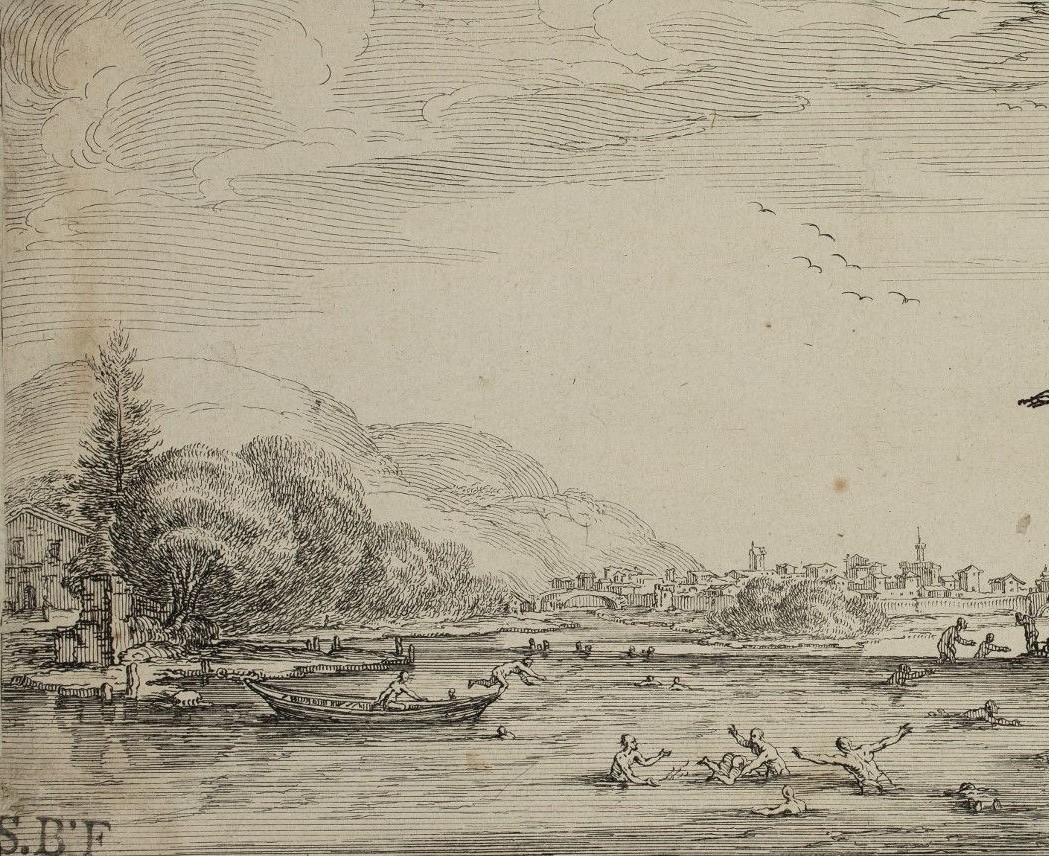
Now for a brief look at a landscape print from the DIA.  I have been having daily flashbacks to our camp on Lake Penage, west of Sudbury.  From the age of 8 or 9, I spent all my summers there, including several after Deb and I had moved to Windsor, gone through university, and got teaching jobs.  So, swimming in a clear, cool lake was not only part of my childhood, but continued well into adulthood.  This was also the location of some of my best and most memorable astronomy nights, despite bugs, wandering bears, skunks, and other various unwelcome night visitors.  Anyway, this image of people swimming caught my eye, and I wish I was one of them today.

The Bathers, ca. 1630 from a series called Various Italian Landscapes.  Jacques Callot, French, 1592-1635.  Etching printed in black ink.  4 5/8" x 9 3/4".  Collection Detroit Institute of Arts.

Detail of right side.

Detail of left side.

Detail of central area. 

We are currently watching a 3 1/4 hour documentary on Marcello Mastroianni, an autobiographical film starring Marcello, as he relates anecdotes and pearls of wisdom gleaned from a lifetime of movie making.  Loaded with film clips and interviews in various natural and indoor settings, so far it is a really enjoyable diversion.  Called I Remember, in one scene he talks about paradise, and how we long for the happy days of our youth.  This certainly fits with my Lake Penage mood these days.  But then he goes on to say that lost paradise is not the only paradise, that there are future ones still awaiting, especially if you are a traveller.  A nice thought, especially if someday we can actually travel safely again.

And last (and probably least) here is a photo of Mr. Piano guy in action.  A shout out to Randy for stopping by to listen to the program, and for the photo.

Maestro Mapman at the keyboard.
 

Mapman Mike